Interview Prep turns one tracked application into a full prep pack: who you're likely meeting and what they're probing for, a tailored question in every area they'll cover with a model answer under each one, the strategy questions to ask back, and a practice mode that scores your own spoken or typed answers out of 100, so you know which ones are actually ready before you're in the room.
Why does interview prep so often stay vague?
The book behind FutureDay is direct about what actually wins an interview: not qualification, preparation. It names two specific jobs preparation has to do, controlling the narrative and removing surprises, not just "thinking about what they might ask." Most people know they should prepare. What they actually do is reread the job ad the night before and hope the right stories arrive on cue once they're in the room.
What does vague preparation cost you?
A career story that runs long and loses the thread halfway through. A behavioral answer given in "we" instead of "I," so the interviewer can't actually tell what you personally did. A hard question, why are you leaving, tell me about a time you failed, that catches you flat-footed not because you don't have an answer, but because you've never said it out loud before, with someone watching your face while you find it.
Why isn't winging it enough, even for someone strong?
Because preparation that only happens in your head doesn't get tested until the room does the testing for you. Rehearsing an answer silently feels like preparing. Saying it out loud, to a real question, under something like real pressure, is what actually reveals whether it holds together in under three minutes or wanders for five.
How does Interview Prep solve it?
It starts by pulling straight from a tracked application, company, role, contacts, so nothing has to be retyped, then asks two quick framing questions, which interview stage this is and what format to expect, competency, case, conversational, before generating the full pack. In a real test run against a live opportunity, the build ran through five visible steps in well under a minute, reading the role and its JD, matching questions to the actual resume behind it, writing questions and model answers, building interviewer profiles, then working out the questions to ask, red flags and closing strategy, each step shown as it completes rather than a spinner with no explanation.
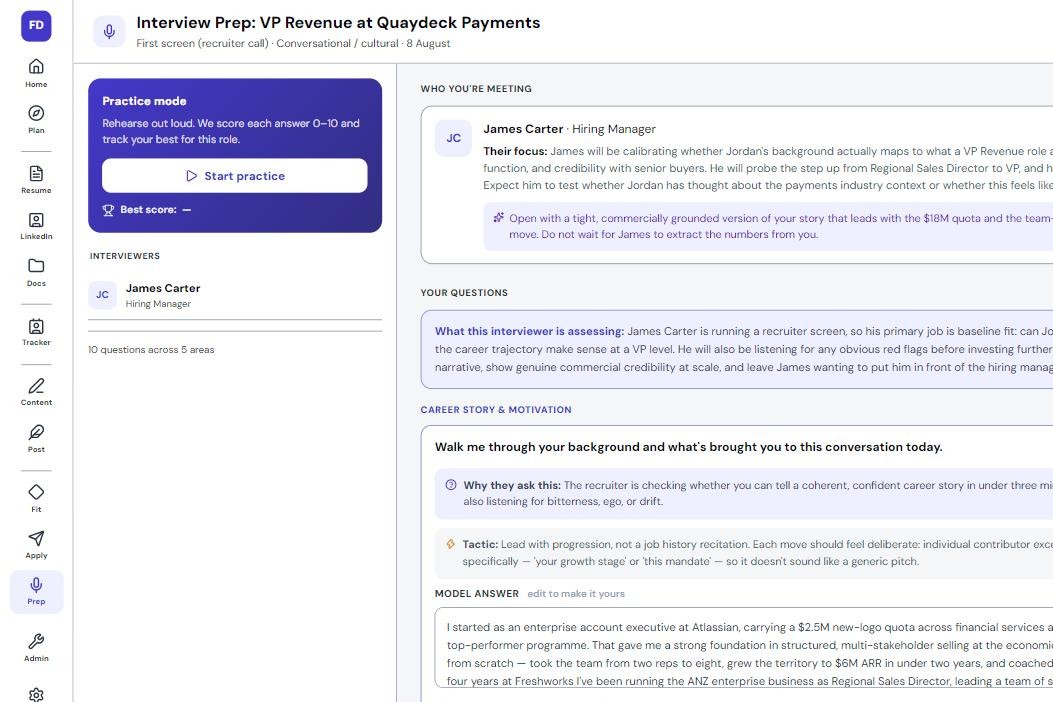
What comes back reads like a briefing, not a quiz. Under "Who you're meeting," each interviewer gets a real profile, name, title, what they're specifically probing for given the actual role and resume, and a one-line note on how to handle it. In one test run against a VP-level revenue role, the interviewer's focus was named directly: calibrating whether the candidate's background genuinely maps to what the role needs, probing the step up in seniority, and testing for a thought-through reason for wanting this specific move, not a generic "tell me about yourself" warning.
The questions themselves are grouped by area, career story and motivation, role-specific, leadership, and every one carries three layers underneath it: why they're actually asking this, a specific tactic for answering it well, not a platitude, and a full model answer written in the first person, ready to edit into your own words rather than copy verbatim. A "Your strategy to win" section names the red flags worth addressing before they're raised as an unspoken doubt, lays out a closing strategy for how to bring the conversation together, and lists the specific questions worth asking back, the kind that show you've thought about the role rather than filling silence.
Then it moves from reading to rehearsing. Practice mode turns the same question set into a live drill: answer by voice or by typing, and each answer gets scored against a running practice score out of 100, with your best attempt for that role tracked so you can see whether you're actually improving or just repeating the same answer. Nothing here replaces the work of building the story. It replaces the version of preparation that only ever happens once, silently, the morning of.
Before: You reread the job ad the night before, silently rehearse a career story that's never actually left your head, and hope the hard question doesn't come up.
After: A full prep pack names your interviewer's likely focus, gives you a tailored answer for every question they're likely to ask, and scores you out of 100 on the ones you actually said out loud.
What changes once you've rehearsed it, out loud, before the room?
The career story stops needing to be assembled live, because it's already been said out loud and scored, more than once, before anyone's watching your face while you find it. The hard question stops being a surprise, because it was named in advance with a tactic attached, not left to hope. Preparation stops being a feeling you had the night before and becomes something you can actually point to, and improve on, the next time you practice.
Preparation, not qualification, is what wins an interview, and it has two specific jobs: controlling the narrative and removing surprises.
Interview Prep builds a full pack from a tracked application in under a minute: interviewer focus, tailored questions with model answers by area, red flags, closing strategy, and questions to ask back.
Practice mode turns that pack into rehearsal, scoring your own spoken or typed answers out of 100 and tracking your best attempt for that role.
The difference isn't having better stories. It's having said them out loud, more than once, before anyone else is listening.
The most qualified person doesn't win the interview. The best-prepared person does. Being the second one just takes rehearsing it once before it counts.