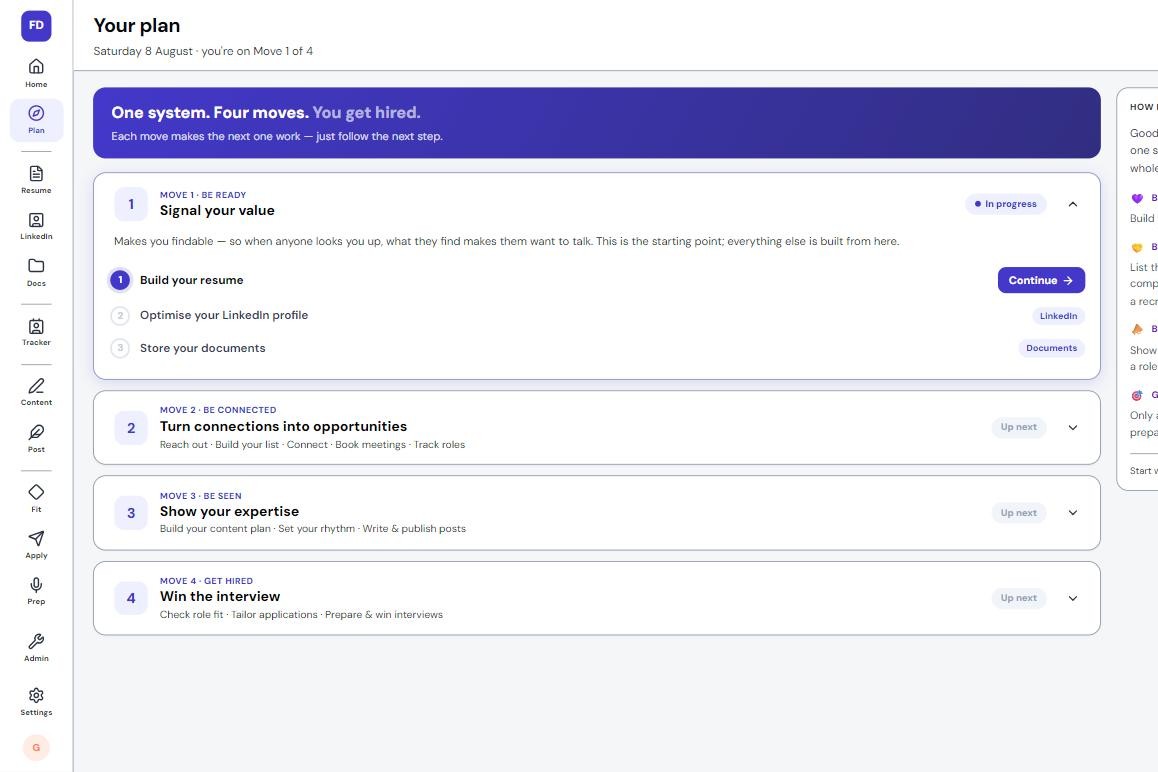
FutureDay runs your job search as one connected system, not a stack of separate tips. Be Ready builds a resume and LinkedIn profile from the same data. Be Connected turns your network and a chosen list of companies into real conversations before a role is posted. Be Seen keeps you visible the whole time. Get Hired turns what surfaces into offers. Stay Ready keeps it all warm for next time.
Picture two doors into the same company. The front door is the public job posting: crowded, slow, and increasingly fake. Greenhouse found that roughly one in five roles advertised on its platform in 2024 were ghost jobs, posted but never really open. The ratio of actual hires to postings has roughly halved since 2019, and the gap between job openings and real hires has run 28 to 38 percent above the pre-pandemic norm every month since 2021. The front door isn't just crowded. Often, it doesn't lead anywhere at all.
The side door is different. It's the role filled through a warm introduction, a follow-up that lands, a name a hiring manager already recognises. It's usually wide open, and almost nobody uses it on purpose. The people who get hired quickly aren't necessarily better than everyone else applying. They're better positioned. This system exists to make that person you, deliberately, instead of by accident.
Most job search advice is a pile of disconnected tips: fix your resume, post more, follow up better. None of it says what order to do these in, or how they connect. FutureDay runs a system instead, because the sequence matters as much as the actions. It breaks into four moves, plus a fifth for after you're hired, and underneath that into twelve phases. Build your foundation once. Reach the people who matter before a role exists. Stay visible the whole time. Convert what comes back into an offer. Then keep it all warm so the next search never starts from zero.
The best-qualified person doesn't win the role anymore. The best-positioned one does. This system exists to make that person you, on purpose.
Move 1: Be Ready, build it once, use it everywhere
Be Ready is Phases 1 and 2. You get clear on the actual role you're targeting, not a vague direction, then catalogue the achievements that prove you can do it, so you stop rebuilding the same materials from scratch every time an opportunity appears.
Two numbers explain why this matters. Recruiters spend an average of 7.4 seconds on a first pass of a resume, a 2018 Ladders eye-tracking figure still cited industry-wide because nothing has really changed. And 88 percent of employers admit that qualified candidates get filtered out of their own hiring process because an application doesn't match the exact words in the job description, per a Harvard Business School and Accenture study. A resume that lists duties instead of results loses on both counts: too slow to scan, too generic to match.
The fix is a formula: swap duty language for outcome language, and the same experience reads completely differently.
Before: "Responsible for business development and managing key accounts across the region."
After: "Built an outbound strategy targeting enterprise healthcare accounts, generating $2.1M in pipeline within six months."
The Resume Builder and LinkedIn Optimiser generate a resume and a profile from the same underlying data, built around that principle, so the two never contradict each other, and Documents keeps every version ready to send in minutes. Your LinkedIn profile has three jobs to do in order: get found, get believed, then demonstrate your authority. This is the foundation every other move draws on. A target list is only useful if you have a resume worth sending. A message to someone on it only lands if the profile it points to backs it up.
Move 2: Be Connected, reach people before the role exists
This is where the method earns its name, Phases 3 through 6: warm network first, then a deliberate target list, job boards for information rather than blind applying, and follow-up so nothing goes cold.
The order matters. Warm contacts come before cold outreach to strangers, because a referral opens doors an application never will. Referrals make up roughly 7 percent of applicants but around 40 percent of hires, according to Jobvite's numbers. It isn't only close friends who move the needle either. A 2022 study in the journal Science, run by researchers from LinkedIn, MIT and Stanford, tracked twenty million users over five years and found looser, weak-tie connections helped people change jobs more often than close ones did.
A target list runs on the same discipline as a sales pipeline: fifteen to twenty-five companies, chosen deliberately, not a name-dump from a job board search. If you can't say in one sentence why a company is on your list, it isn't a target list yet. It's just a search history. The Pipeline module runs this as a real CRM for your career, contacts, companies and opportunities, each one staged and never left to memory, with job boards used last, to find the person behind a posting rather than to submit into a pile of hundreds.
Move 3: Be Seen, running in parallel, not after
Be Seen is Phase 7, and it runs alongside the other moves, not after them. By the time you reach out to someone on your target list, there's a good chance they've already seen you somewhere: a comment, a post, a shared article. Psychologists call this the mere-exposure effect. Familiarity builds trust before a conversation even starts, and being good at your job is invisible until someone has a reason to look.
Most visibility efforts fail because people post without deciding what they actually want to be known for. A content plan answers three questions: what do you want to be known for, who is it for, and which few themes will you actually keep coming back to. The difference between an ownable message and a forgettable one is specificity.
Before: "Experienced operations leader."
After: "I help scaling companies fix the operational chaos that arrives right after fast growth."
A Buffer analysis of more than two million posts found people who post at a steady, moderate cadence, around three to five times a week, get meaningfully more reach than people who post in bursts. The Content Plan, Content Calendar and Post Writer make consistency sustainable: a plan built around what you actually want to be known for, a calendar that keeps a light rhythm going, and a writer that drafts in your own voice.
Move 4: Get Hired, turning a pipeline into an offer
Get Hired covers Phases 8 through 11, the part most job search advice starts and ends with. It works because the first three moves already did the hard part.
Before you spend an evening on an application, it's worth answering three honest questions: can you actually get this role, are you genuinely strong for it, and is it actually right for you. Skipping that third question is the most common trap, a role can look winnable and still be the wrong move. The Job Fit Checker runs this test before you invest the hours. Tailoring, done properly, isn't a rewrite, it's a reshape: mirror the role's language, lead with the most relevant proof, cut what doesn't serve this application. The Tailored Resume does exactly that.
Interviews are won the same way, preparation beats qualification. Interview Prep scores practice answers against a three-minute career story, and against the questions almost everyone gets asked and almost nobody prepares for. Winning the interview isn't the finish line either. What you do with the offer in the days after is worth thousands, starting with buying yourself a day or two before you say yes.
What happens after you're hired?
Phase 12 is Stay Ready, and it's the part most systems skip entirely. Once you land the role, your account can drop into Maintain mode: resume and profile kept current, network relationships kept alive at their own natural rhythm, all for a few minutes a month. Grow mode keeps the visibility habit running too, for anyone building toward the role after this one. Nothing gets thrown away. The next search, whenever it comes, starts from everything you already built instead of from zero.
What staying where you are actually costs
It's worth being honest about the cost of not doing any of this. Every extra month spent out of work, or stuck in a role you've outgrown, is roughly a month's salary you don't get back, and that's before the cost to confidence and momentum. Forty scattershot applications, properly tailored, can burn a full working month for a fraction of the return one well-placed conversation delivers.
One reader who built this method, a 48-year-old laid off suddenly after fifteen years at one company, sent forty applications the traditional way and heard almost nothing back. He stopped applying blind and went to the people who already knew him instead. One introduction from a former colleague turned into an offer six weeks later, for a role that had never been advertised. Nothing about him changed between the two approaches. Only the door he used did.
Do I need to be a salesperson or a natural networker to do this?
No. If anything, the opposite. The system is built for people who don't identify as extroverts, don't already have a big network, and dislike pitching themselves. It works by handing you one clear next step at a time and letting you follow it, in your own voice, at your own pace.
Who is FutureDay actually for?
Anyone serious about their next role who's tired of applying into silence. The software is tuned across most fields now, including engineering, finance, marketing, people and sales, plus a general track for everything else, and it covers early-career through senior professionals. The method underneath works in any career, because it was never really about the field. It's about how hiring actually happens.
Be Ready: your resume and LinkedIn profile, built once from the same data, using the formula that turns duties into results.
Be Connected: your warm network and a deliberate target list, worked as a real pipeline, because referrals still beat applications by a wide margin.
Be Seen: visibility running the whole time, not bolted on afterward, built on a message you can actually own.
Get Hired: a fit check, a tailored application and real interview practice, turning conversations into offers.
Stay Ready: everything kept alive for a few minutes a month, so the next search never starts from zero.
None of this replaces the work of getting hired. It just means you're never doing that work from scratch, or alone.