The Tailored Resume takes one job you're applying to and reshapes your resume and cover letter around it: what to lead with, which of your own achievements prove it, and the exact keywords the screening software is scanning for. Every change comes with the reasoning behind it, shown before it happens, and a full application, resume and cover letter both, comes together in minutes with editing controls at every section.
Why does tailoring take so long, even when you know it matters?
The book behind FutureDay is blunt about this: tailoring is not rewriting. It's three specific moves, mirror the language of the role, lead with your most relevant proof, and cut what doesn't serve this particular job. That's a clear instruction. It's still an hour or more of real work for a single application, deciding which of ten years of achievements to lead with, rewriting a summary so it echoes the job ad's own words, checking a cover letter actually answers why this role, why you, why now instead of reading like a form letter with the company name swapped in.
What does skipping it actually cost?
Most people don't skip tailoring because they don't understand it matters. They skip it because doing it properly, for every application, is more time than a search has room for. So the same resume goes out ten times with the same summary and the same bullets in the same order, and the cover letter opens with a line generic enough to belong to any company. Screening software built specifically to look for a job ad's own phrasing quietly filters out resumes that never bothered to speak its language, no matter how genuinely qualified the person behind it is.
Why isn't a quick edit enough?
Because tailoring well is a judgement call, not a substitution. Deciding which achievement counts as relevant proof for this role is a different answer for a payments company than for a cybersecurity vendor, even from the same underlying career. Making that call properly, eight or ten times a week, on top of everything else a search involves, is exactly where good intentions quietly stop turning into finished applications.
How does the Tailored Resume solve it?
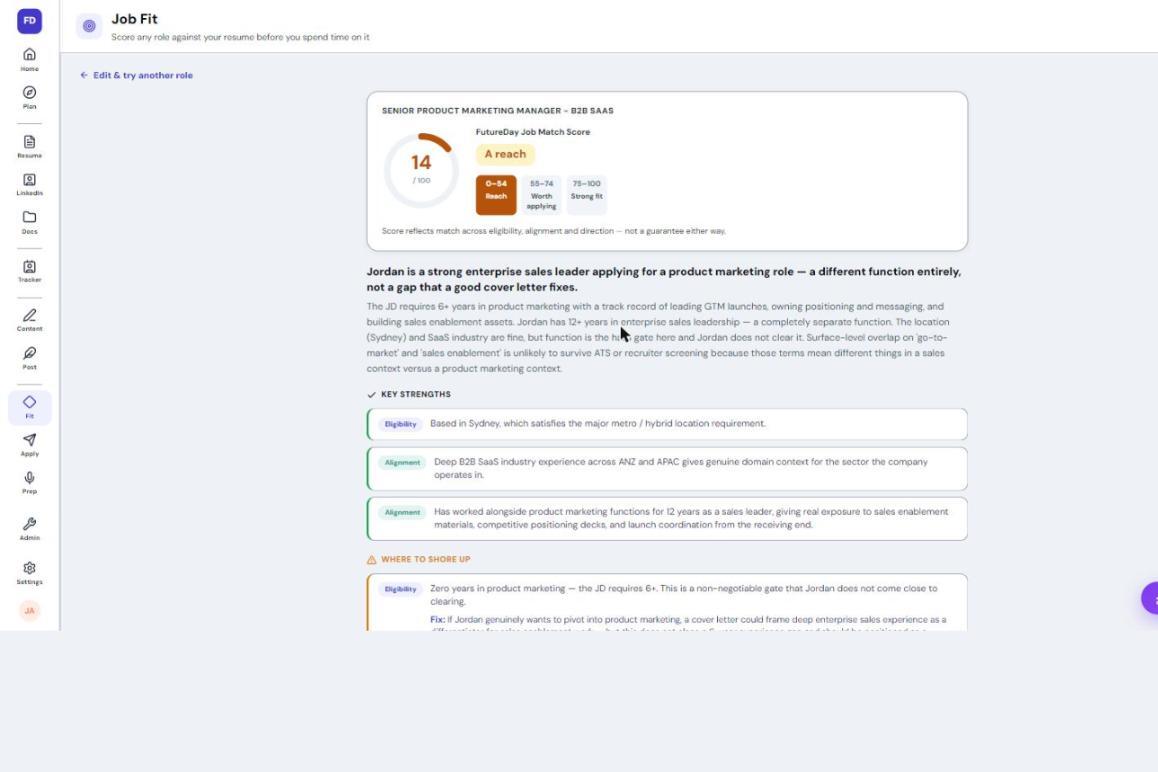
It starts from a decision that's already been made. Once a role has been scored through the Job Fit Checker and cleared as worth applying for, that same fit result carries straight into a five-step wizard, Fit, Approach, Resume, Cover letter, Review, each one a checkpoint you can see and adjust rather than a single AI pass you're asked to trust blindly.
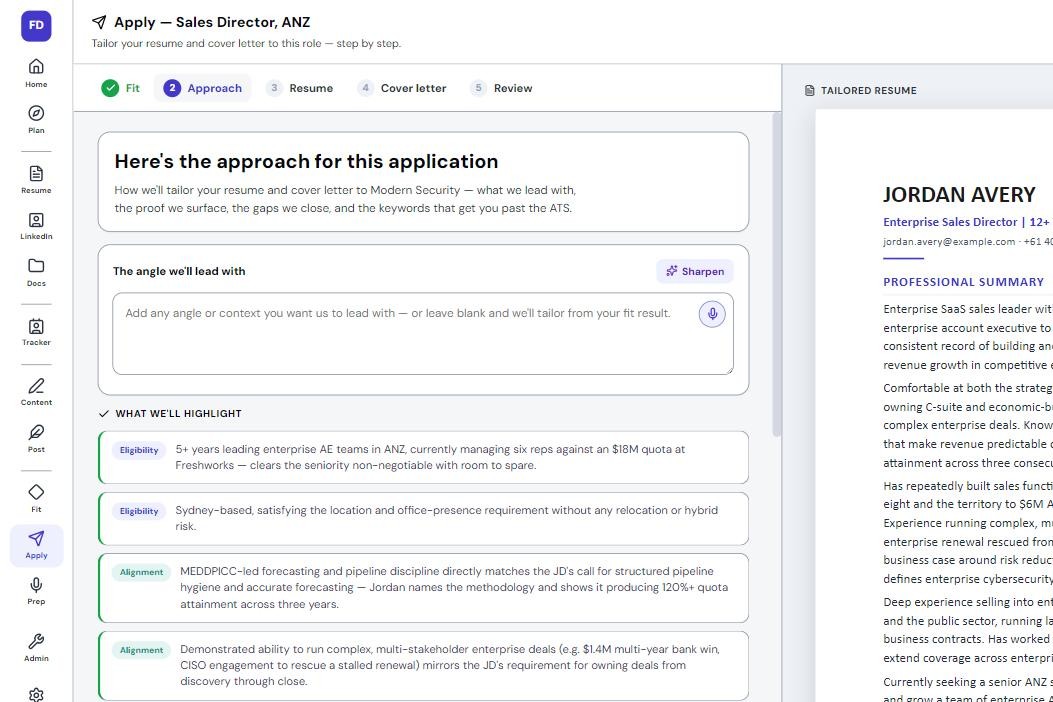
The Approach step lays out the plan before a word of the resume changes. In a real test run, a Sales Director application into a cybersecurity company, it opened with the angle it planned to lead with, editable, with a "Sharpen" option if the first pass wasn't sharp enough, then a "What we'll highlight" list tagged by the same eligibility and alignment language the Job Fit Checker itself uses. Five-plus years leading enterprise account teams in the same region, tagged eligibility, because it clears a seniority requirement with room to spare. A specific multi-year deal that rescued a stalled renewal by working the economic buyer relationship directly, tagged alignment, because it mirrors the job ad's own requirement for owning complex deals start to finish. Nothing generic, no "results-driven professional," just the specific proof this particular role is actually asking for.
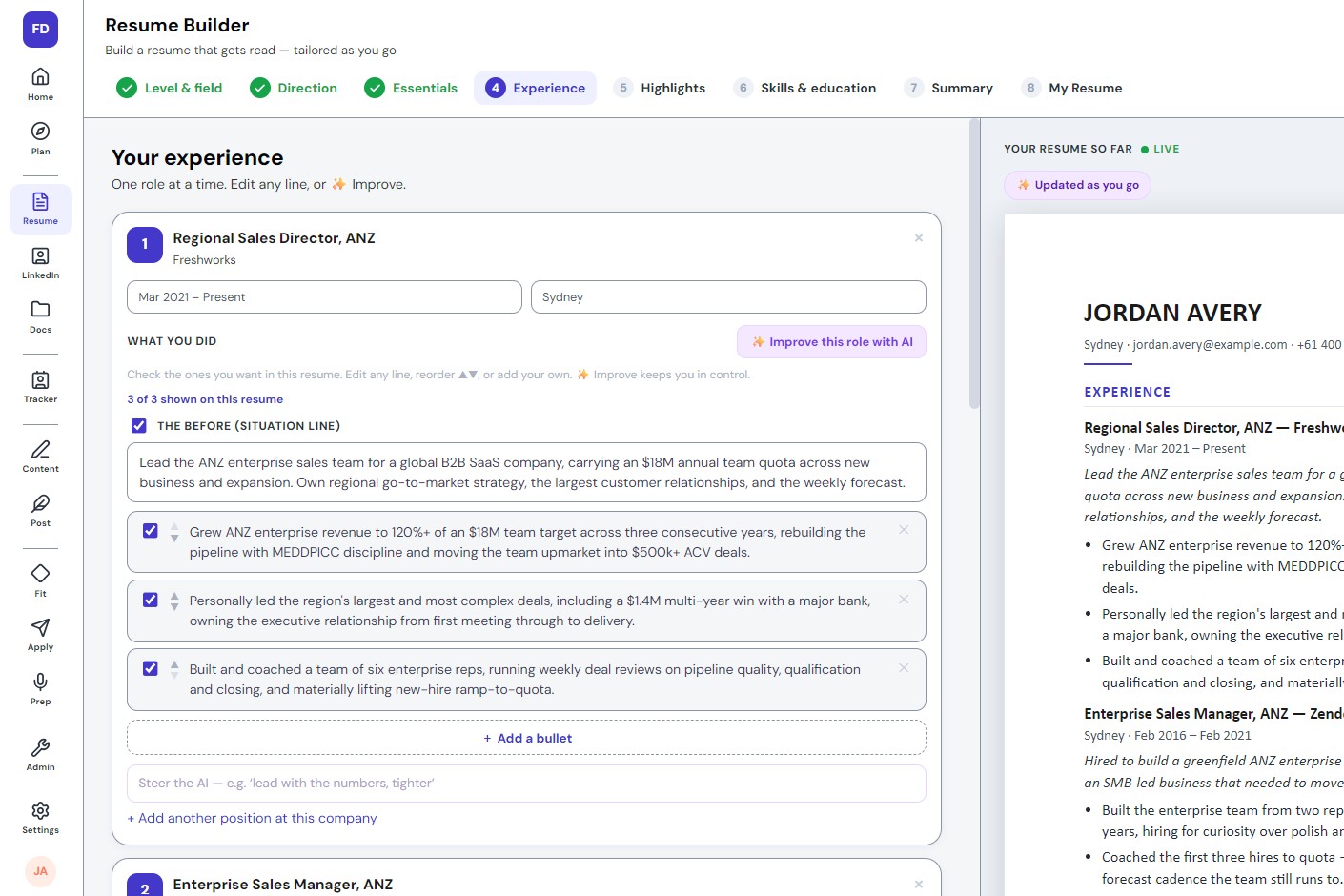
From there the resume rebuilds section by section next to the plan, headline first, tuned to the language of the role it's targeting rather than a generic version of the same career. Every section carries its own controls, an "Improve" option and a "Steer the AI" prompt, so a first draft is a starting point to push back on, not a final answer to accept. A row of ATS keyword chips lets you see and toggle exactly which of the job ad's own terms get woven in, so the resume can speak the screening software's language without turning into a document stuffed full of terms no human would actually write.
The cover letter builds the same way, and it's held to the same test the book teaches: a cover letter isn't a summary of the resume, it's a short case for why this role, why you, why now, specific enough that covering up the company name would make it stop making sense. By the Review step, that test run had landed on eight sections tailored and eight of the job ad's own keywords woven in on purpose, with a .docx export ready to send and a "Save to Tracker" option that logs the tailored version straight back into the same pipeline the application is being tracked in.
Before: The same resume and the same bullets go out to every role, with a cover letter vague enough to fit any company that opens it.
After: Eight sections rebuilt around one specific job, eight of its own keywords woven in on purpose, and a cover letter that names the exact problem this employer is actually trying to solve.
What changes once tailoring stops being the bottleneck?
The hour or more that tailoring used to cost per application stops being the reason a strong-fit role gets sent a generic resume anyway. The judgement calls, which achievement to lead with, which words to mirror, what to cut, still get made. They're just made fast, with a reason shown for each one, instead of skipped under time pressure. What used to be a choice between doing it properly for two roles or doing it badly for ten stops being a choice at all.
Tailoring properly, mirroring the role's language, leading with relevant proof, cutting what doesn't serve it, takes real judgement and real time, which is why it's the first thing to slip under pressure.
The Tailored Resume carries a role straight from its Job Fit Checker result into a five-step wizard, Fit, Approach, Resume, Cover letter, Review, each one visible and editable, not a single AI pass to trust blind.
Every highlight is tagged to the exact evidence behind it, every keyword choice is visible and toggleable, and every section can be pushed back on before it's sent.
A genuinely tailored application goes from an hour of decisions to minutes of checking the reasoning, without lowering the bar on either the resume or the cover letter.
A tailored application says I want this role. A generic one says I want any role. The difference used to cost an hour. Now it costs a few minutes of checking the reasoning instead.