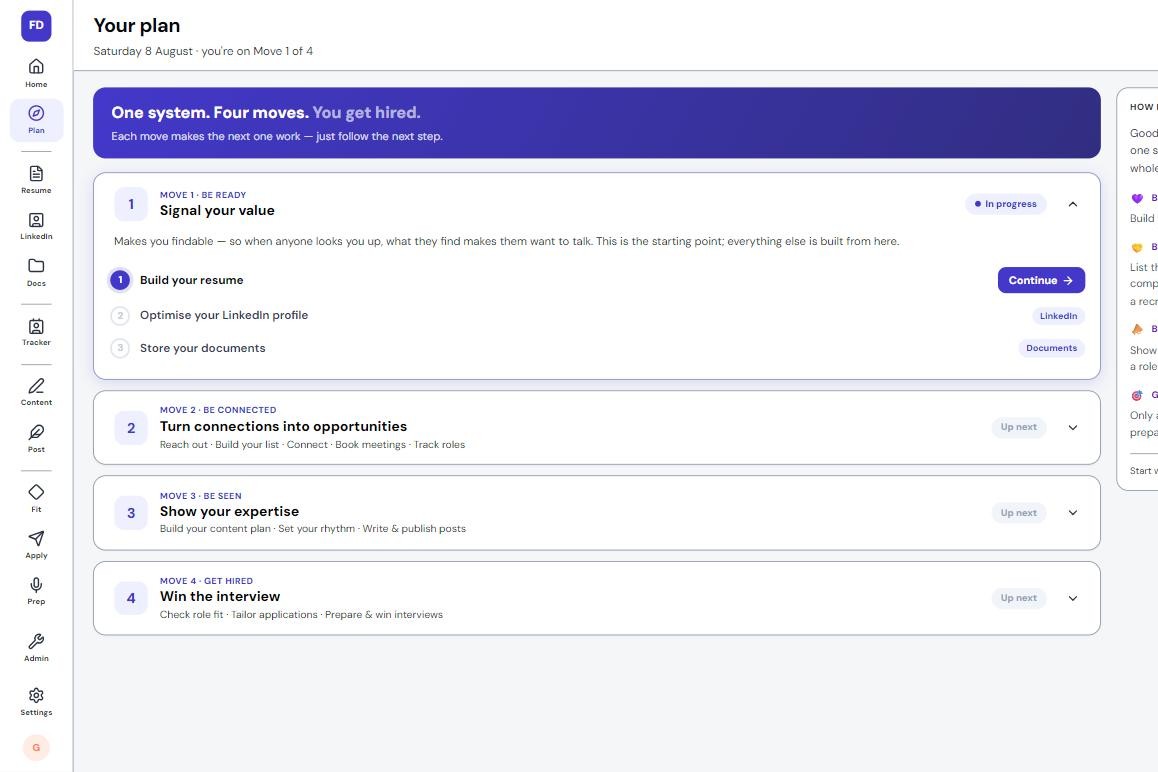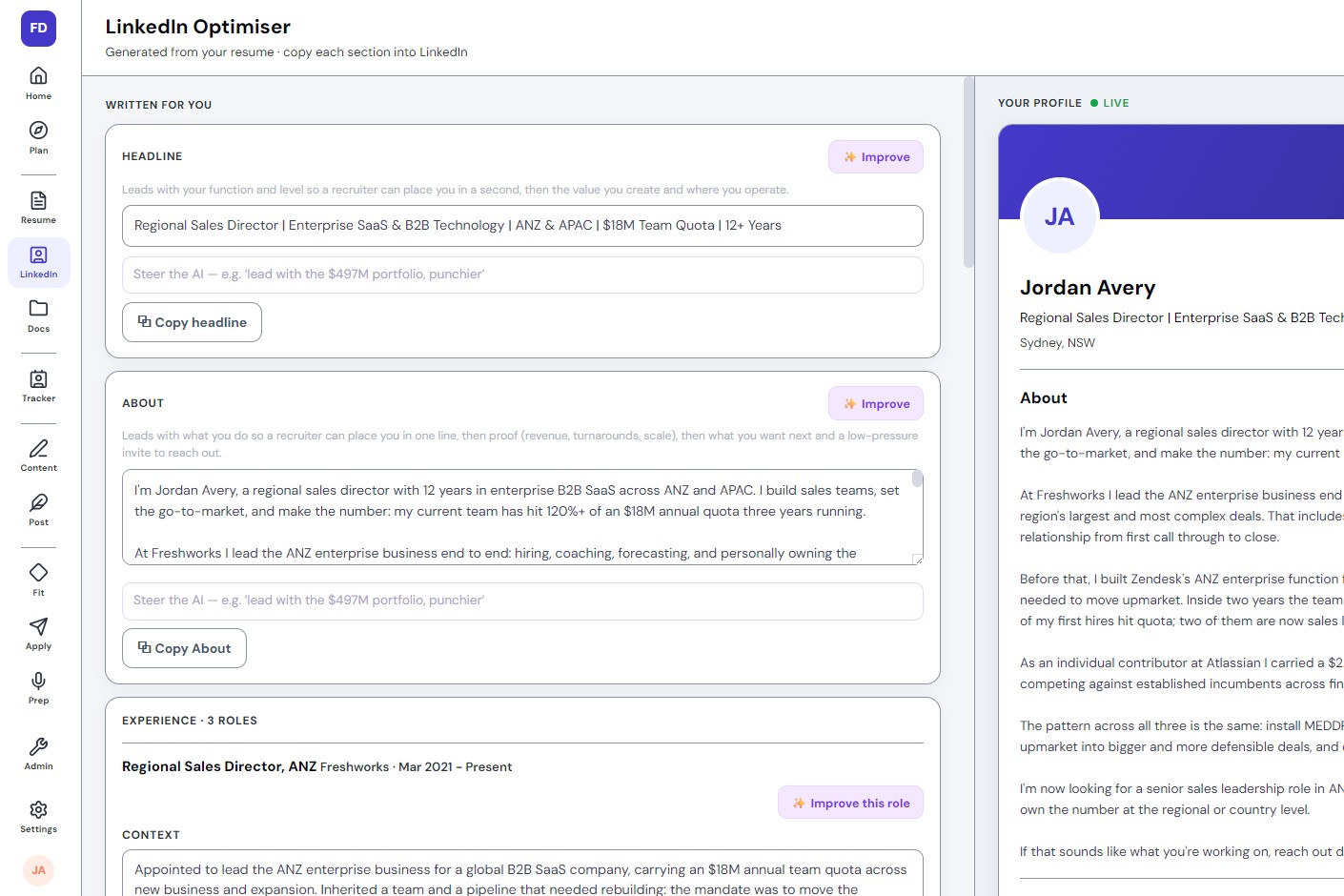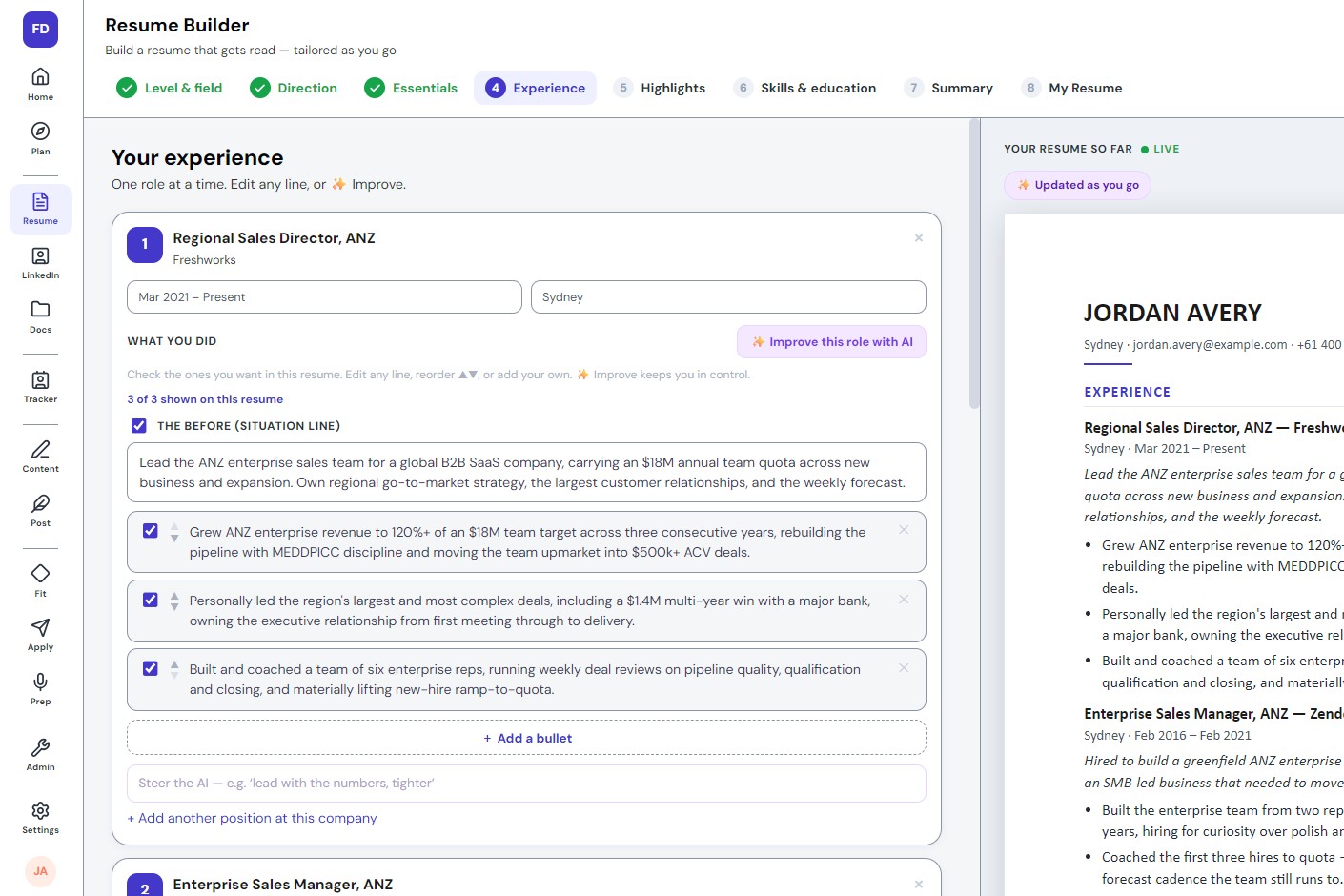
The Resume Builder walks you through your career step by step and turns what you enter into achievement-led bullets instead of duty lists, built on the same five principles taught in the FutureDay method: future-focused, quantified, "so what"-tested, relevance over length, first page sells the interview. Improve rewrites any line on request, Steer refines it further in your own words, and a live preview updates as you go.
Most people build a resume the same way: open a blank document, try to remember what they did at each job, and write it down roughly in the order it happened. The result reads like a job description, because that's effectively what it is. A hiring manager scanning it in under ten seconds has no way to tell you apart from the twenty other candidates who wrote almost the same thing.
Why do most resumes lose before anyone reads them?
Two gatekeepers, stacked on top of each other. The first is software: 99.7% of recruiters now use an applicant tracking system to screen candidates before a person opens anything, and it's unforgiving about formatting and keyword matching. The second is the human on the other side of that filter, who studies show spends an average of 7.4 seconds on a first pass. Underneath both is the same root problem: most resumes list duties instead of results. "Responsible for managing key accounts" tells a reader what your job was called. It says nothing about whether you were any good at it.
Why does that actually cost you?
It's not a small gap. In one widely cited study, 88% of employers admitted that qualified candidates get filtered out of their own hiring process simply because an application doesn't match the exact wording of the job description. That's not a talent problem. It's a wording problem, and it's fixable, but only if you know what the software and the recruiter are actually each screening for, and most people never find out until after the silence.
Why can't you easily fix this yourself?
Most people genuinely can't see their own resume's weak spots. The achievements you've undersold are invisible to you precisely because you lived them and assume everyone can tell what they took to pull off. On top of that, the numbers that would make a bullet land are usually the first thing forgotten, most people don't capture a win the week it happens, so by the time they sit down to update a resume, "grew the account" is all that's left of what was actually a specific, quantifiable result. A resume writer will catch some of this, for a few hundred dollars, once, for one version, and the moment your career moves on, that version is already out of date again.
How does the Resume Builder solve it?
It's built on five principles: be future-focused rather than a history lesson, quantify whatever you honestly can, make every line answer "so what," let relevance beat length, and make the first page do the work of selling the interview. Rather than hand you those as advice and leave you to apply them, the builder applies them for you as you go, through a short, guided sequence: level and field, so it knows what "good" looks like for your kind of role, a direction for where you're headed next, the essentials, then experience built one role at a time. Add as many roles or positions as your career actually has, work through each one bullet by bullet, choose which achievements make the cut, reorder them, or add your own, then close with a skills and education pass and a written summary. Every step saves automatically, and a live preview shows your actual resume updating on the right as you go, so you always know exactly what you're sending.
Every bullet also has an Improve option next to it. It doesn't invent achievements you didn't have. It takes the situation you describe and pushes it toward the specific, measurable version of the same fact, the kind of line that survives a seven-second scan. If the result isn't quite you, Steer it: type a note like "lead with the retention number" or "make it punchier" and it rewrites again, in the direction you actually meant.
Before: "Responsible for managing enterprise accounts and reporting on sales performance."
After: "Grew a $6M enterprise account base 22% year-over-year by rebuilding the account review cadence and catching at-risk renewals earlier."
That's the "so what" test applied consistently, bullet after bullet, role after role, rather than caught occasionally on the one line you happened to think hardest about.
What happens to your resume once it's built?
It doesn't sit alone in a folder. The same underlying data feeds the LinkedIn Optimiser, so your profile and your resume tell the same story instead of quietly contradicting each other, and every version saves to Documents, ready to pull straight into a tailored application in Apply the moment you find a role worth applying to. Built once, it's reused everywhere the rest of the system needs it, which matters because most people don't need one resume. They need a base document they can reshape in minutes for every role that's actually worth their time.
Most resumes lose to two gatekeepers at once, the ATS and a recruiter who gives you seconds, because they list duties instead of quantified results.
The Resume Builder applies the five principles, future-focused, quantified, "so what"-tested, relevant, first-page-strong, to a short guided sequence: level and field, direction, experience, highlights, skills, summary.
Improve turns duties into specific, measurable proof across every bullet, not just the ones you happened to think hardest about; Steer refines it further in your own words.
A live preview and autosave mean nothing is lost and nothing is a surprise at the end.
Once it's built, it becomes the source data for your LinkedIn profile, your Documents library, and every tailored application after it.
A resume that gets read isn't a better-formatted version of the same list. It's a different list entirely, one built around proof instead of duties, and built once so you never have to start from a blank page again.