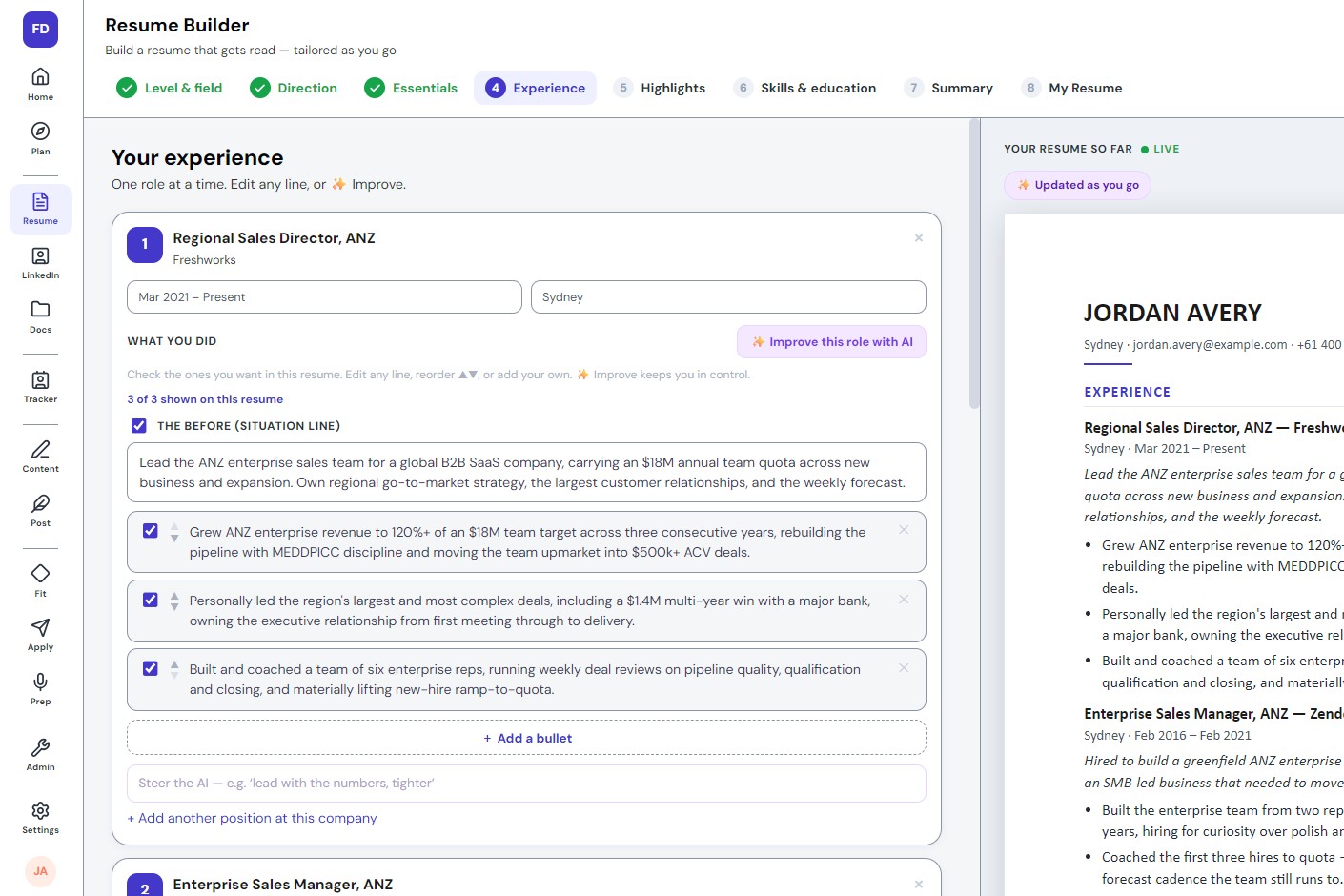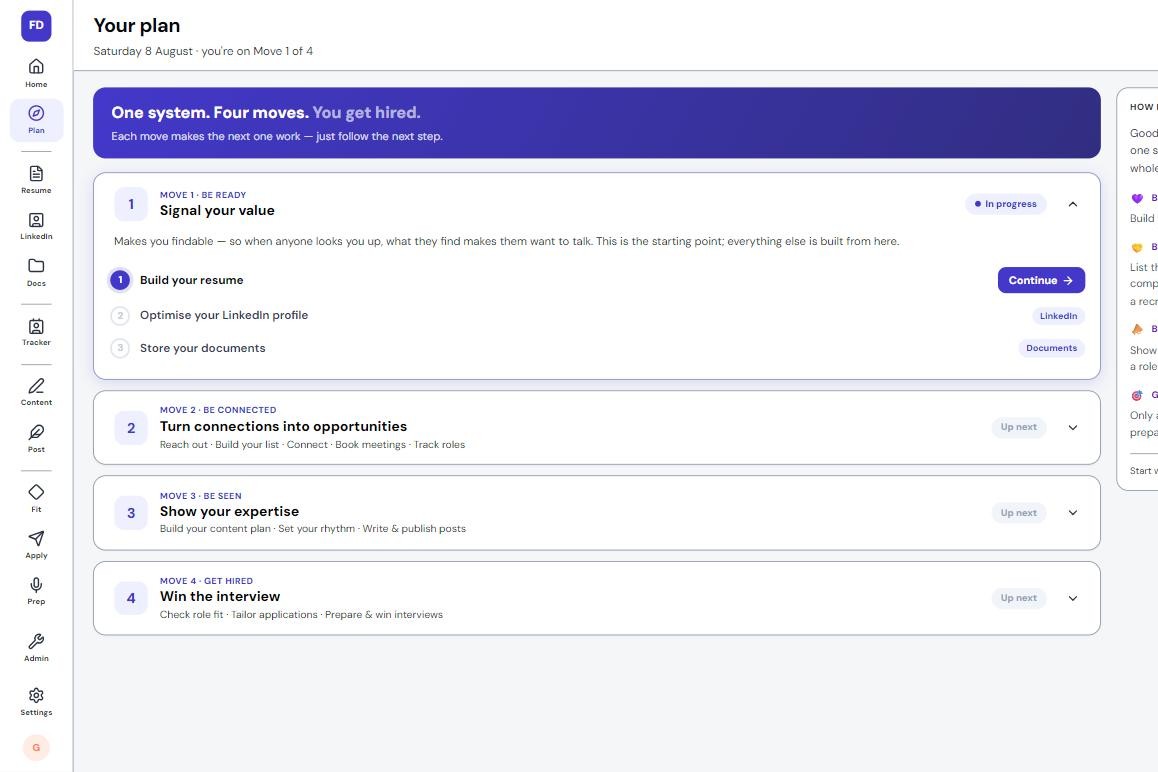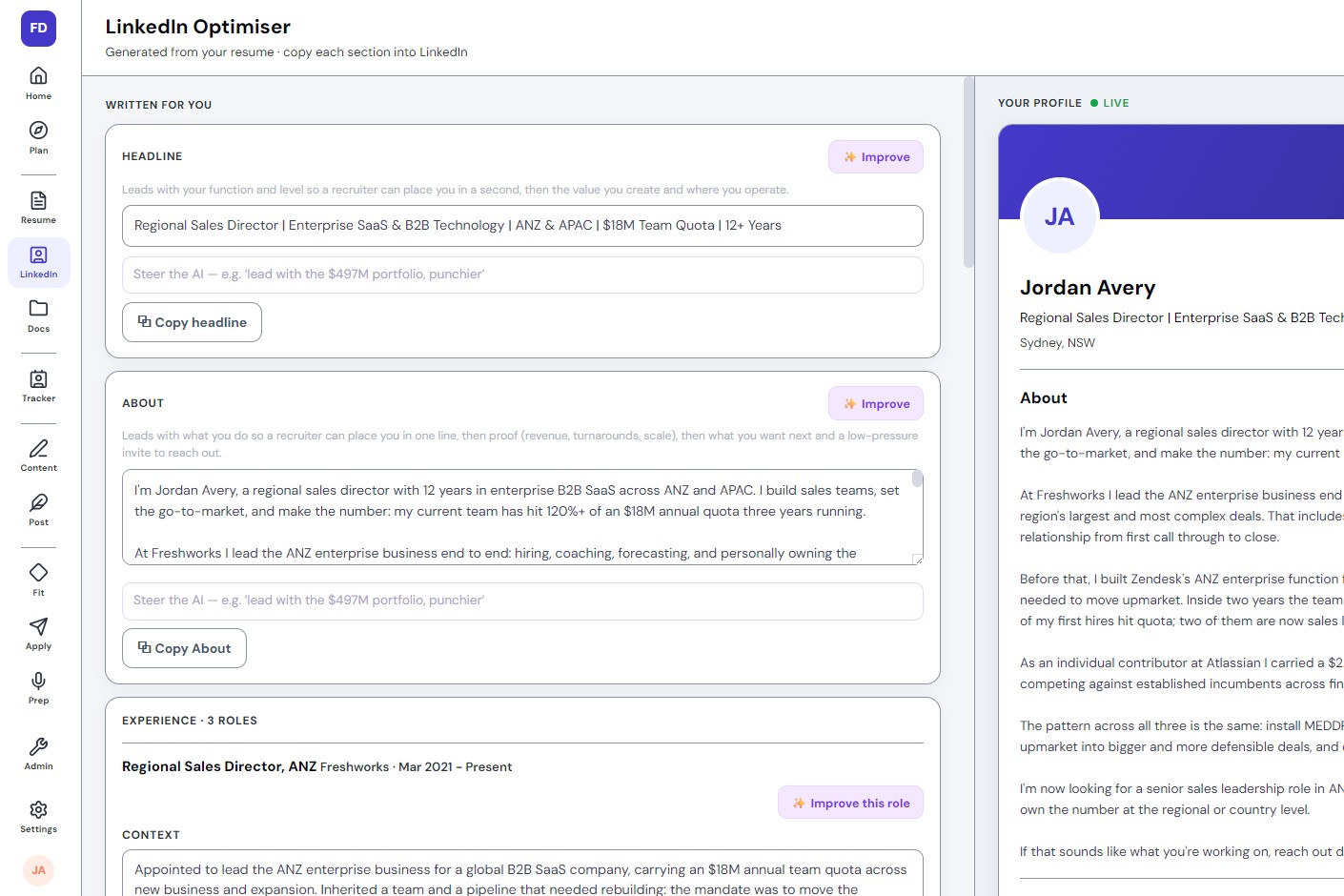
The LinkedIn Optimiser is generated from your finished resume, not a blank form, and it's built around the three jobs a profile actually has to do: get found, get believed, and demonstrate authority. It writes your headline, About, every role and a prioritised skills list, Improve and Steer refine any section in your own words, and a live preview shows the real profile you're about to publish before you copy a single field across.
A resume and a LinkedIn profile are trying to do two different jobs. A resume gets read by one person, for one role, after they've already decided to look at it. A profile gets found by search, scanned in seconds by a stranger deciding whether you're worth a message, and left sitting there as your default answer to "who is this person" for everyone who looks you up in between. Most people write one and copy it into the other. It shows.
Why can't you just copy your resume onto LinkedIn?
Because a resume is written to be read start to finish, and a LinkedIn profile is written to be scanned in fragments, a headline someone sees in a search result, an About paragraph someone skims before deciding to keep reading, a skills list a recruiter's search tool matches against before a human ever looks. Pasting resume prose into a profile solves neither job well. The method behind the Optimiser breaks a profile into exactly three jobs, in order: get found (your headline and skills, the searchability layer), get believed (your photo, banner, About, experience, education and recommendations, the trust layer), and demonstrate your authority (Featured and your posts, the proof-of-expertise layer). Most unfinished profiles fail at the first job and never get a chance at the other two.
Why does that actually cost you?
A recruiter decides whether you're worth a message inside seconds of landing on your profile, before they've read a single sentence properly. Every hour you spend networking or posting content sends people to that profile. If it reads like an unfinished resume, the rest of your effort quietly undercuts itself, the introduction lands, and then the profile behind it fails to close the loop.
Why can't you easily fix this yourself?
Writing your own About section is one of the hardest short pieces of writing most people ever attempt: describing your own value, in your own voice, without either underselling it or drifting into the same generic language everyone else uses. Most first drafts read like "a highly motivated, results-driven professional with a proven track record," a sentence that could belong to almost anyone and therefore belongs to no one. Getting from that to something specific takes either real practice or a second pair of eyes that already knows the formula, and most people have neither on hand the day they sit down to fix their profile.
How does it turn one resume into a full profile?
It starts from what the Resume Builder already knows about you, so nothing has to be re-entered, then rewrites each section for how LinkedIn is actually used. The headline leads with your function and level so a recruiter can place you in a second, then the value you create and where you operate. The About section leads with what you do in one line, then proof, results, scale, the kind of thing a resume buries in bullet three, then what you're looking for next with a low-pressure invitation to reach out. Every role gets its own rewrite, and a bank of 30 skills is prioritised, not just listed, for the terms recruiters actually search and the ones applicant systems match on first. Improve refines any section on request, and Steer takes it further: add a note like "punchier" or "lead with the $34M number" and it rewrites again in that direction. A live preview shows your actual profile updating as you go, so you see exactly what you're about to publish.
Before: "A highly motivated, results-driven professional with a passion for excellence and a proven track record across a range of industries."
After: "I help enterprise software companies turn flat sales teams into predictable revenue engines. I have led teams of up to 40 across four markets and grown recurring revenue to over $20M. I am now looking for a VP of Sales role in enterprise SaaS."
The first version could belong to almost anyone. The second could only belong to one person, which is exactly what makes a recruiter stop scrolling and start reading.
What can't AI write for you, and how does it help anyway?
Some of what makes a profile work isn't text. Your photo alone carries real weight: profiles with one get roughly 21 times more views and 9 times more connection requests than profiles without. Your banner image, what you pin in Featured, how you present education and licences, the recommendations you have or don't, none of that can be generated either. Most people either skip these entirely or guess, and getting them wrong quietly undercuts everything else on the page, the "get believed" and "demonstrate authority" jobs never get finished even after the words are right. So instead of pretending otherwise, the Optimiser gives you a short do-and-avoid guide for each one: what actually belongs in Featured for a job search, the formula a banner should follow, a template for requesting a recommendation that will actually say something useful. The parts only you can do get made easier, not skipped.
What happens after your profile is optimised?
Every section has its own Copy button, so you paste each one straight into LinkedIn's own editor, one field at a time, with no guesswork about what goes where or where you left off. The finished profile saves to Documents alongside your resume, and from there the natural next step is Be Seen: a profile that's actually ready to receive the traffic your content sends to it, instead of quietly undercutting every post you write.
A profile has to do three jobs in order, get found, get believed, demonstrate authority, and most unfinished profiles never get past the first one.
The Optimiser generates your headline, About, role descriptions and a 30-term prioritised skills list directly from your finished resume.
Improve refines any section; Steer takes it further in your own words, and a live preview shows exactly what you're about to publish.
It gives you a clear guide for the visual and human parts of a profile that AI can't write for you, including why your photo alone can be worth 21x the views.
A finished profile is a prerequisite for Be Seen, not an afterthought to it.
Most "finished" LinkedIn profiles still aren't getting anyone hired, not because the person behind them lacks achievements, but because those achievements were never translated into the words a profile actually needs.