The Voice Profile is built from your own answers, spoken or typed, to real questions about your career, your personality and what you won't compromise on, plus any writing you paste in yourself. FutureDay uses it to draft cover letters and posts that sound like you, then runs a separate signal check on the result so you can see, in plain numbers, whether it still reads like AI.
Why does AI-written job search content all start to sound the same?
Type "cover letter for a sales director role" into any generic AI tool and you'll get something fluent, polished, and almost identical to what the next hundred people asking the same tool will get. The book behind FutureDay warns against exactly this kind of writing: "highly motivated, results-driven professional with a proven track record" is the sound of someone who let the tool do the thinking, not the writing.
What does that actually cost you?
The whole point of a cover letter or a LinkedIn post is to sound like a specific person a hiring manager would want to meet. Generic AI output undoes that on contact. Hiring managers read enough of it now to recognize the pattern in seconds, and the tell isn't bad grammar, it's the absence of anything a real person would actually say. The candidate underneath the words disappears, and disappearing is the opposite of what a cover letter is for.
Why can't you just write it yourself, or just tell the AI to "sound more natural"?
Because most people, asked to describe their own voice, freeze. You know your own writing when you read it, but you can't easily hand a stranger, or a language model, a formula for it. And telling a generic tool to "sound more like me" doesn't work if it was never given anything real about you to draw from in the first place. It has no signal to work with, so it defaults to the same safe, average tone it gives everyone else.
How the Voice Profile actually captures your voice
It starts with a question bank, fifteen questions across three sections, Work & Career, Personality & Energy, and Values & How You Operate, each answerable by speaking or typing. The questions aren't generic either: "What's the career story you find yourself telling people, the one that actually explains how you got here?" "What's a principle you won't compromise on, even when it would be easier to?" "What's something completely outside work you get genuinely excited or a bit obsessive about?" The guidance is explicit that you don't need to answer all fifteen: a couple from each section works better than fifteen from just one, because, as the page puts it, FutureDay looks for words you use across different topics, not exact wording.
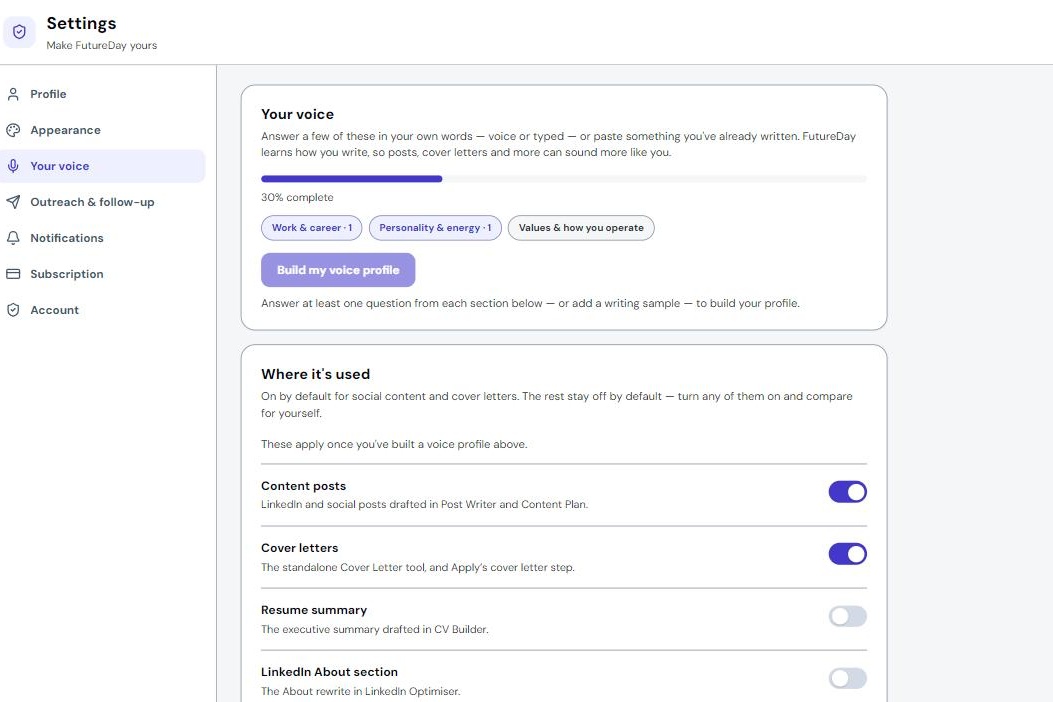
In a real test, answering just two questions, one from Work & Career, one from Personality & Energy, took the profile from 0% to 30% complete, with a live counter on each section showing exactly how many you've answered so far. You can also paste in something you've already written, an email, a post, a message, and tag it yourself: all me, AI helped polish it, or not sure. That honesty matters, since it tells the system how much weight to put on that sample versus your direct answers.
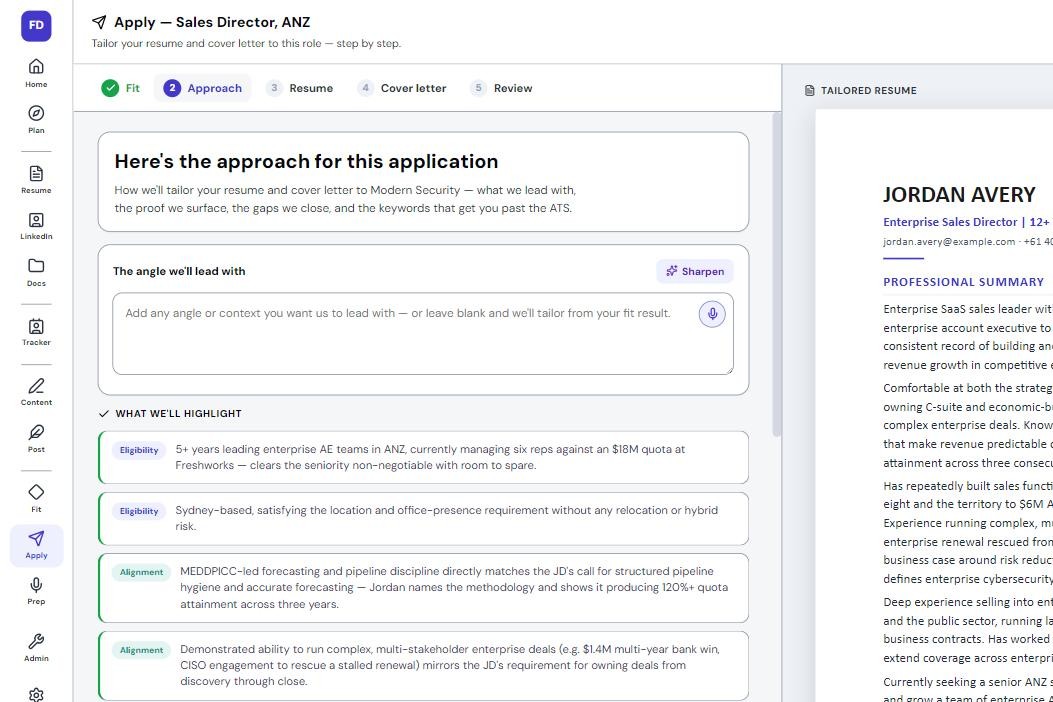
Once it's built, the profile doesn't apply itself everywhere by default. Five separate toggles control exactly where it's used: content posts in Post Writer and Content Plan, the standalone cover letter tool and Apply's cover letter step, the executive summary in CV Builder, the About section rewrite in LinkedIn Optimiser, and, most carefully scoped of all, just the positioning and summary at the top of a tailored resume in Apply, explicitly never the skills, experience or education sections underneath. Content posts and cover letters are on by default. Everything else stays off until you turn it on and compare the difference for yourself.
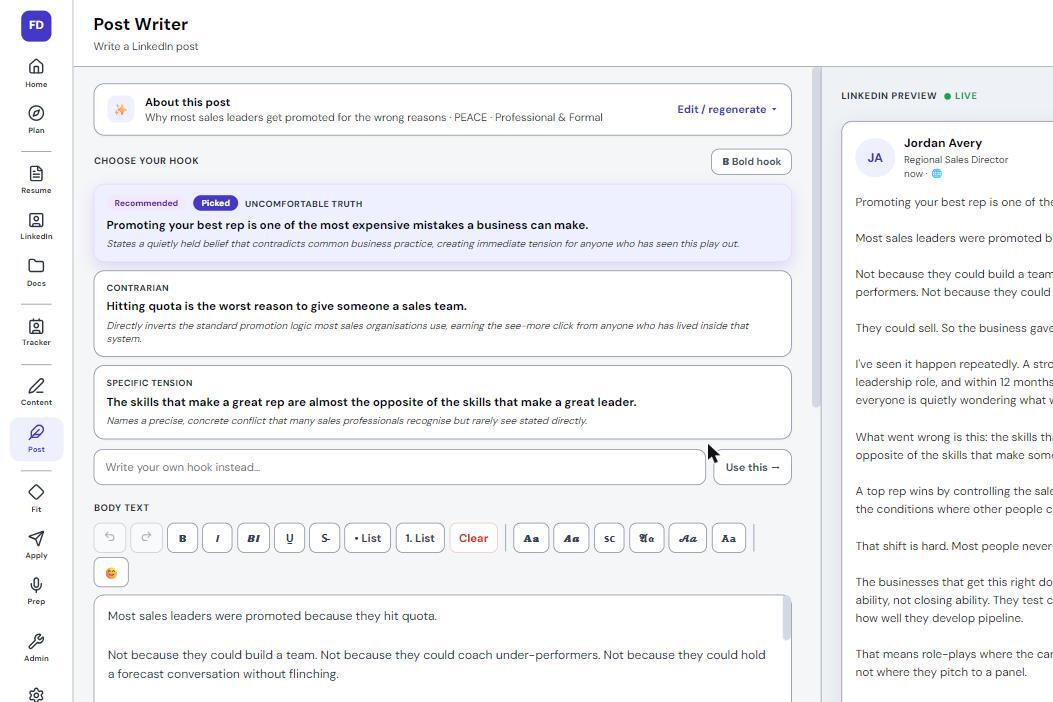
The other half of the system is a separate check, not more AI trying to sound human, but a guardrail scoring the writing itself once it exists. In Post Writer, before anything goes live, a signal check runs on the finished post. A real test came back at 100 out of 100: "low AI signal, strong writing, no flags." That's the same read-it-back-before-you-hit-send instinct the book asks a person to do by hand, built into the tool instead of left to memory.
Before: "A highly motivated, results-driven professional with a passion for excellence and a proven track record across a range of industries."
After: "I help enterprise software companies turn flat sales teams into predictable revenue engines. Over 18 years, I have led teams of up to 40 and grown recurring revenue to over $20M."
What changes once your writing actually sounds like you?
A cover letter stops reading like it could have been sent by anyone applying to anything, and starts reading like the specific person a hiring manager might actually want to meet. You keep full control over where that voice gets used, on by default only where it matters most, off everywhere else until you decide otherwise. And because a separate check scores the result rather than another layer of AI just reassuring you it's fine, you get an honest number, not a guess, on whether it's still doing its job.
Generic AI writing has no real signal to work from, so it defaults to the same safe tone for everyone.
The Voice Profile is built from your own spoken or typed answers to real questions, plus any writing you paste in and tag yourself.
Five separate toggles control exactly where your voice gets used, cover letters and posts on by default, everything else opt-in.
A separate signal check scores the finished writing itself, the same read-it-back instinct the book teaches, built into the tool.
The goal was never to sound impressive. It was always to sound like you, on your best day.