Content Plan, Calendar and Post Writer are three connected FutureDay tools, not three separate ones. Plan turns four named themes into twelve fully drafted LinkedIn posts. Calendar puts them on the days you'll actually post. Post Writer is where any post, from the plan or from scratch, gets a final pass, with a hook picker and a check for whether it reads as AI-written before it goes live.
Most people who try to build visibility on LinkedIn skip the one decision that actually makes it work. They open the app, think of something to say, post it, and repeat that whenever the mood strikes. Nothing connects one post to the next. A recruiter scrolling through six weeks of history sees a resume tip, a motivational quote, a rant about a Monday, and no throughline at all.
Why does most job-seeker LinkedIn content go nowhere?
The book behind FutureDay puts it plainly: a content plan is the answer to three questions, what you want to be known for, who it's for, and what you'll keep coming back to. Skip that decision and you get what the book calls the confused feed, a mix of topics with no position behind any of them, or the all-about-me feed, which talks at a reader instead of for them. Either way, nobody remembers what you're actually known for, because you never decided.
What does posting without a plan actually cost you?
The psychological mechanism behind visibility content is the mere-exposure effect: people trust what they've seen repeatedly, even without consciously registering it. That only works with repetition on the same few themes. A Buffer analysis of more than two million posts found a real gap between people who post on a regular cadence and people who post in bursts, with the sweet spot sitting around three to five times a week and returns flattening above that. One strong post followed by three weeks of silence never gets the chance to compound. It just resets.
Why is this hard to keep doing on your own?
Even once someone accepts they should post consistently, sustaining it means holding several things in your head at once: pillars specific enough to be ownable but broad enough not to run dry in a fortnight, a posting schedule you actually keep, and LinkedIn's own mechanics, no hashtags, links penalised in the post body, edits penalised after publishing, the first hour deciding most of a post's reach. On top of that, you need a fresh hook every time and some honest way of checking whether what you just wrote reads like it came from a person or a chatbot. Most people can hold one or two of those. Almost nobody holds all of them, every week, for months.
How do Plan, Calendar and Post Writer solve it?
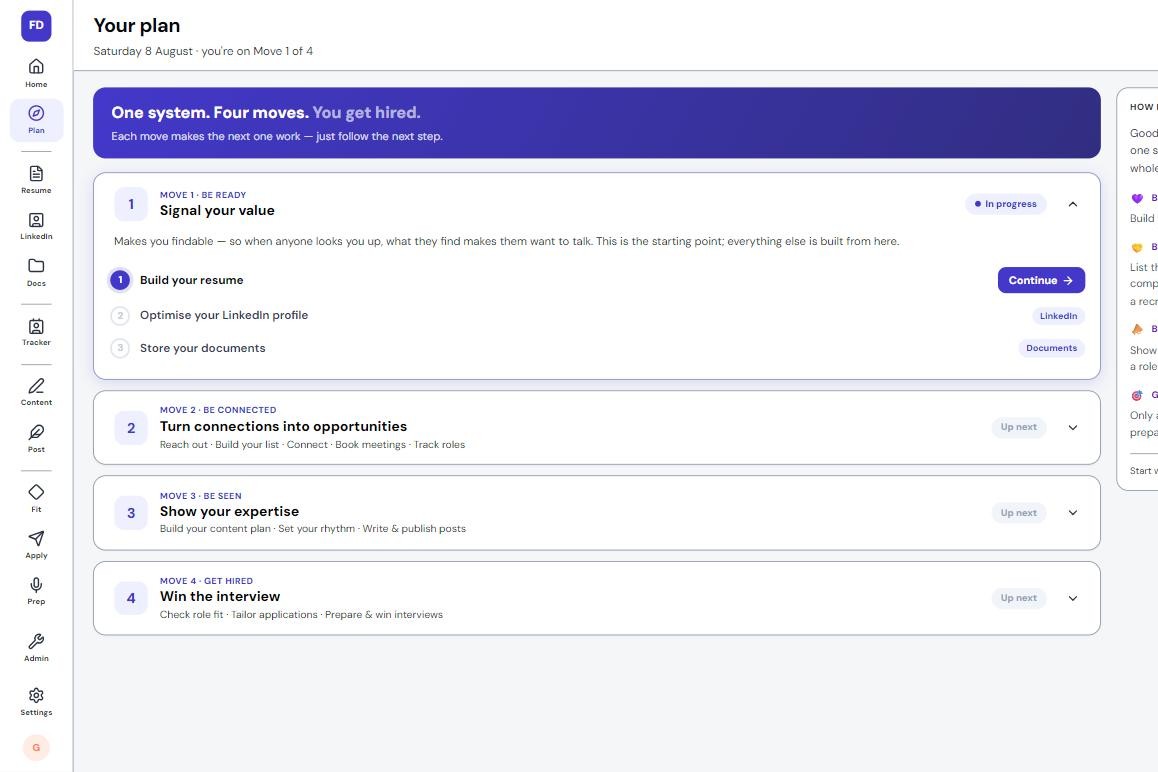
Plan starts by forcing the decision the book calls the whole job. It builds a messaging layer from four fields: the surface problem your reader has, the frustration underneath it, the belief you hold about it, and your actual position, the specific thing you're the person to say. From there it sets four pillars, each with a fixed share of posts and a funnel-stage tag, top, middle or bottom of funnel, so the mix stays deliberate instead of random. Then it writes twelve full LinkedIn posts in one pass against those pillars, three a week for four weeks, each one already carrying three selectable hooks tagged by the tension they use, a contrarian angle, an uncomfortable truth, a sharply specific detail, plus a ready first comment for the engagement window.
Sitting alongside the posts is the actual playbook, not just the output: a seven-point LinkedIn format guide covering line breaks, hook length, the "you" over "I" ratio, why hashtags and in-body links now hurt reach, and a hard word-count ceiling, a do's and don'ts list, and the 60-Minute Rule spelled out step by step, because the mere-exposure effect only pays off if the early-engagement mechanics are right too.
Once the twelve posts exist, Calendar puts them on the actual days chosen for posting. Load all twelve in one click and they land on the schedule automatically, or load them one at a time. A running count, how many posted, how many still to go, keeps the discipline visible instead of something you have to remember is even happening.
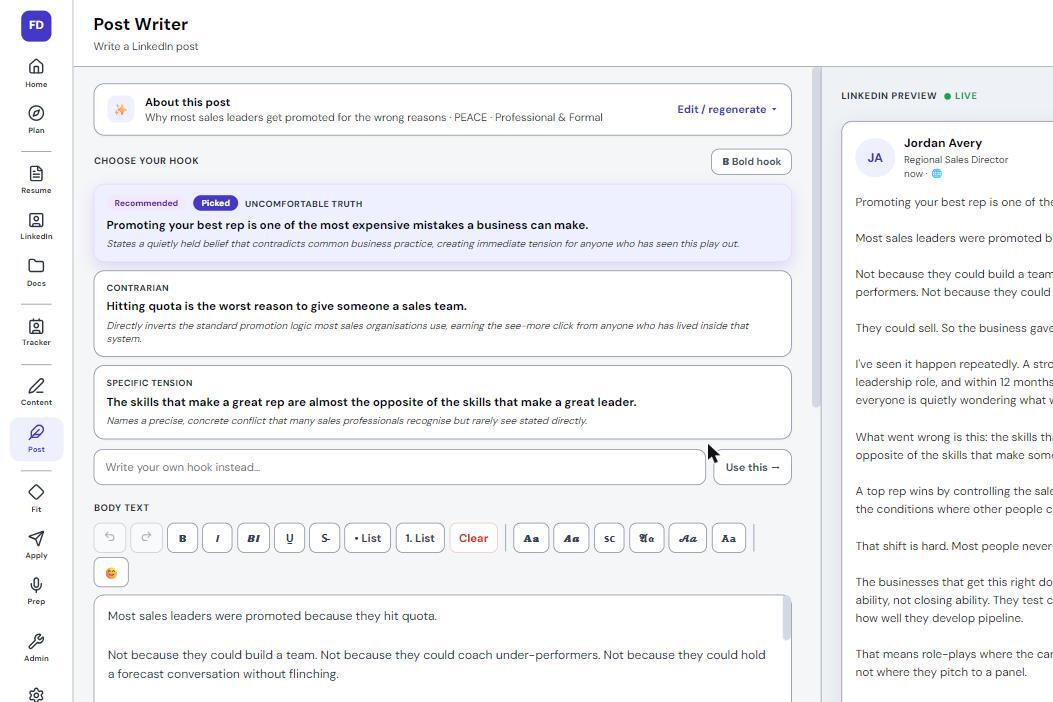
Any single post, whether it started in the plan or from a blank page, opens in Post Writer for a final pass. Pick from eight formats and four tones, generate a fresh draft body-first, then choose or rewrite the hook, and a live LinkedIn preview shows exactly how it reads on mobile or desktop before it goes anywhere. Before you save it, a signal check scores the writing itself. A real test run came back at 100 out of 100, "low AI signal, strong writing, no flags," the same read-it-back pass the book asks a person to do by hand before publishing.
Before: Posting whenever an idea shows up, on whatever topic crosses your mind, easy to abandon by week two once the ideas stop coming.
After: Twelve posts already written against four named pillars, scheduled to the same three days every week, each one checked for AI signal before it goes live.
What changes once your visibility runs on a plan?
Posting stops being something you have to remember to start. It's already scheduled, so what's left is the one part no software can do for you, showing up in the first hour to reply. The pillars compound too. Because every post ties back to the same few themes, someone scrolling your profile after your Job Fit score comes back sees a consistent, ownable position instead of a scattered history, which is exactly the point of Move Three of the method this whole module is built from.
Most LinkedIn content fails before it's written, because nobody decided what it's actually for.
Plan forces that decision, then turns it into four pillars and twelve fully drafted posts in one pass.
Calendar puts those posts on the days you'll actually keep, with a visible streak instead of a vague intention.
Post Writer gives any post a final pass, a live preview, and a signal check, so what goes live reads like you, not like AI.
Talent gets forgotten. Showing up, usefully and often, is what gets remembered, and the plan for doing that now exists before you've written a single line.