The Pipeline is FutureDay's CRM for your job search: every contact, target company, live opportunity and follow-up task in one connected system, each staged so you always know what's next. Move a contact from Connected to Meeting, or an opportunity from Applied to Interviewing, and every task, note and related person linked to it moves with it, instead of living in your memory.
A real search touches more people and companies than anyone can hold in their head. FutureDay's own tracking, built to mirror a genuine search, carries fifty contacts, twenty target companies, ten live opportunities and sixteen open tasks at once, each at a different stage, each needing something different done next. That's not an unusually busy search. That's roughly what Move Two of the method actually looks like once you're doing it properly, and almost nobody tracks it anywhere except memory, or fragments of it split across an inbox, a notes app and a spreadsheet that's already out of date by week two.
Why does that actually cost you?
The FutureDay book is blunt about where opportunities actually go: "Most opportunities are not lost to a 'no.' They are lost to silence, yours, because no one was keeping the opportunity alive." A good conversation with a hiring manager doesn't usually end in rejection. It ends in nothing, because nobody set a reminder to follow up, and by the time you remember, three weeks have passed and reaching out again feels strange instead of natural.
Why can't you just track this yourself?
Because staying on the front foot, the book's own phrase for this, means holding a lot of state at once: which stage each of thirty-plus relationships is at, what the next action is, and when it's due. The book lists this out as five habits, tracking every opportunity through its stages, always having a next action, following up because almost no one does, keeping several things alive at once, and treating rejection as information rather than a stop sign. Each one is simple on its own. Doing all five, for thirty relationships, every week, without anything reminding you, is where it breaks down.
A spreadsheet can technically hold all of that. Nothing about a spreadsheet reminds you to open it, though, or flags what's gone quiet, so the discipline collapses the moment real volume hits, usually somewhere around the third or fourth live opportunity, right when it matters most.
How does the Pipeline solve it?
It runs as four connected views instead of one long list, each staged the way the method actually moves.
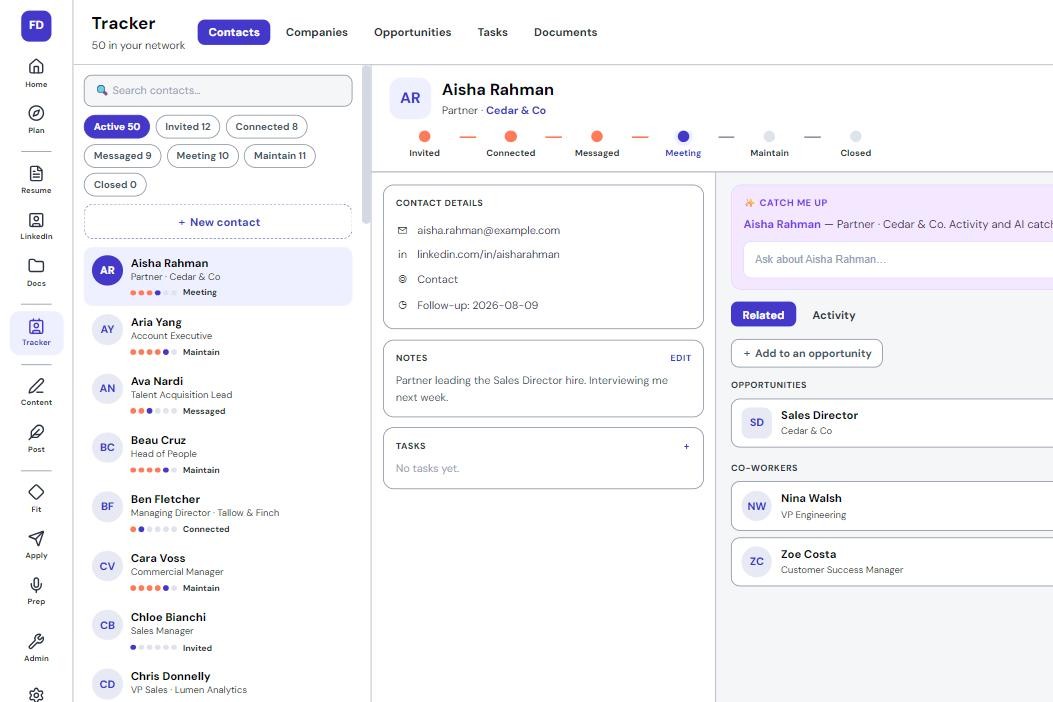
Contacts move through Invited, Connected, Messaged, Meeting, Maintain and Closed, the same warm-network cultivation the book teaches in Move Two. Each one carries notes, a follow-up date, linked opportunities, and the co-workers you also know at the same company, and an AI "Catch me up" summary, so you're never opening a conversation cold because you can't remember what you last discussed or who else there is worth knowing.
Companies move through Prospect, Researching, Targeting and Engaged, mirroring the deliberate target-list building the book spends a full chapter on: fifteen to twenty-five companies chosen on purpose, not a name-dump pulled from a job board search. A one-click Research pulls together what's worth knowing about a company before you reach out, and every contact and opportunity tied to it shows up automatically underneath, so a company entry isn't just a name, it's the whole relationship you've built there so far.
Opportunities move through Saved, Applied, Screening, Interviewing, Offer and Closed, closely mirroring the book's own pipeline-stage list, built directly into the software. Each one carries the role details that matter, salary range, location, how you found it, when it was posted, plus notes and its own task list. Each one also links straight to a fit score, the job description, and interview preparation, so the whole back half of a search, judging the role, tailoring for it, preparing for it, runs from one record instead of four separate tools you have to keep in sync yourself.
Tasks inherit a link back to whoever or whatever they're about, and sort themselves into Overdue, Today and Upcoming. "Always have a next action" stops being a discipline you have to remember and becomes something the software just shows you.
Before: A promising conversation with a hiring manager trails off because nothing was scheduled, and three weeks later following up feels awkward instead of natural.
After: The conversation creates a task automatically. Miss the date, and it sits in Overdue until you deal with it, not until you happen to remember.
What changes once your search runs on structure instead of memory?
Nothing goes quiet just because you forgot. A rejection stops being a dead end too, since working the loss, going back to a company once someone else fills the seat you were chasing, only works if that company is still on your list, with a real contact and real history attached to it. In the Pipeline it already is, staged and ready, instead of a name you'd have to reconstruct from scratch weeks later.
It also means you can genuinely run several things at once, a habit the book calls keeping several opportunities alive at once, without any of them slipping because your attention was on a different one. The Pipeline doesn't care which opportunity you looked at last. It just shows you what's overdue, today, and this week, across all of them.
A real search moves too many people and companies at once for memory or a spreadsheet to hold reliably.
Contacts, Companies, Opportunities and Tasks each run on their own stages, mirroring how the method actually moves people from stranger to offer.
Everything is linked: a task knows who it's for, a company shows its contacts and opportunities, an opportunity links straight to fit, the job description and interview prep.
Nothing goes cold from silence, because the system tracks the follow-up so you don't have to remember to.
Most job searches don't fail loudly. They fail quietly, from things that were simply never followed up on. The Pipeline exists so nothing gets the chance to go quiet on you, and so the search runs on what you actually did, not on what you remembered to do.