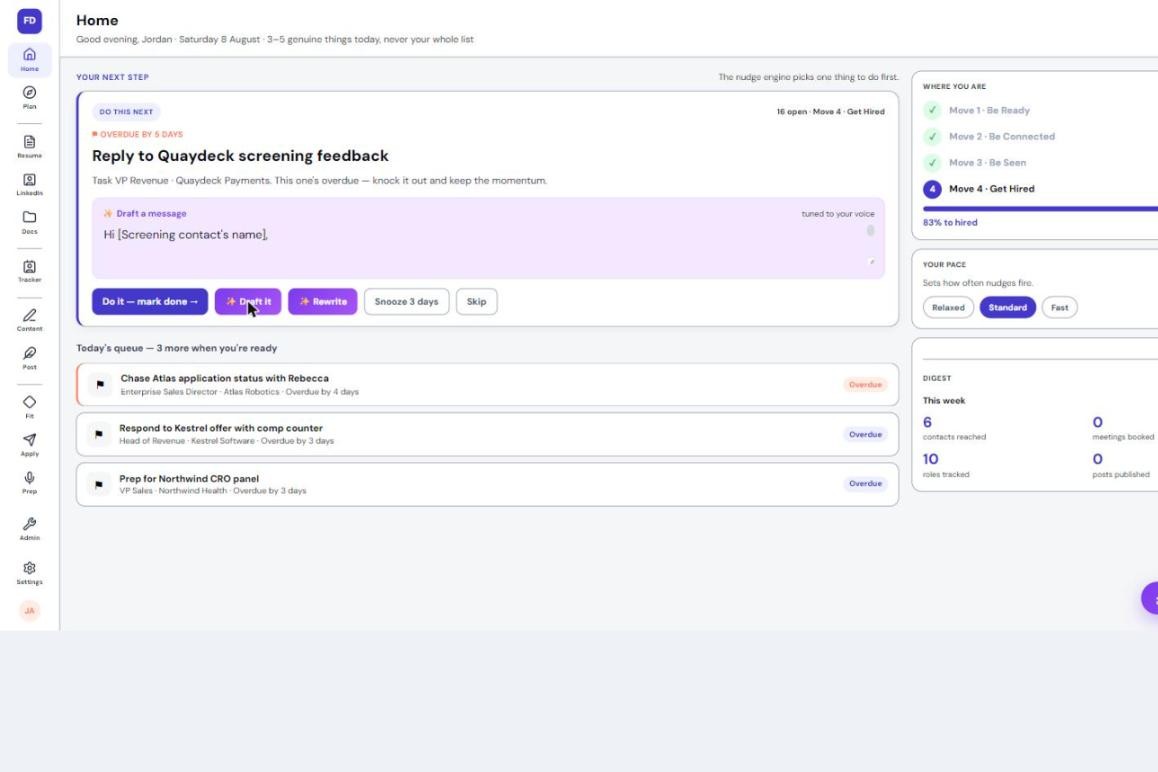
A job search has no manager, no deadlines and no queue, just forty things that might matter. That is why it is so tiring, and why people fall back on applying: applying at least feels like doing something. The fix is not more effort. It is a smaller decision each day: one next step, about five things, and one place that remembers everything so nothing is quietly forgotten.
If you are trying to work out how to organise a job search, the first thing to know is that the hard part is not the work. It is deciding what the work is, every single morning, with nobody to ask. Take that decision off your plate and the search gets simpler and far less draining.
Why is a job search so tiring when you are not doing much?
Because deciding is work, and a search is almost all deciding. At a job, most of the day is already shaped: a manager sets priorities, meetings fill the calendar, and a queue of requests tells you what comes next. In a search, none of that exists. You wake up to a blank page and a list that never ends: update the resume, check the boards, message someone, follow up on something, research a company, prepare for a call that might happen.
Every item looks important and none of them has a due date. So each morning starts with the same tiring question, "what should I do today?", and there is no one to answer it but you. By lunchtime you have spent your best energy choosing, and done very little.
That is why applying becomes the default. It is concrete, it has a finish line, and a confirmation email proves something happened. It feels like work, even when it is the least effective thing on the list.
What should a day contain?
Fewer things than you think, in a fixed order. A good search day has one clear next step and a handful of smaller ones behind it. Five is about right: enough to keep several threads moving, few enough to finish.
Those five should come mostly from people, not job boards. A follow-up with someone who replied last week. A first message to a former colleague. A thank-you after a call. One look at a company on your list. Maybe one application, if a role is a genuine fit.
Before: A to-do list of thirty-one items, none dated. Two hours on job boards, one application, and a vague sense that Priya was meant to get a follow-up at some point.
After: Five things today. Follow up with Priya, who is due. Message two former colleagues. Send the thank-you from Tuesday's call. Apply to the one role that fits. Done by ten.
When the five are done, the day's search is done. That matters as much as the list itself. A search with no finish line leaks into every evening, and a search that leaks into every evening is the one people quit.
How do you know you are not forgetting somebody?
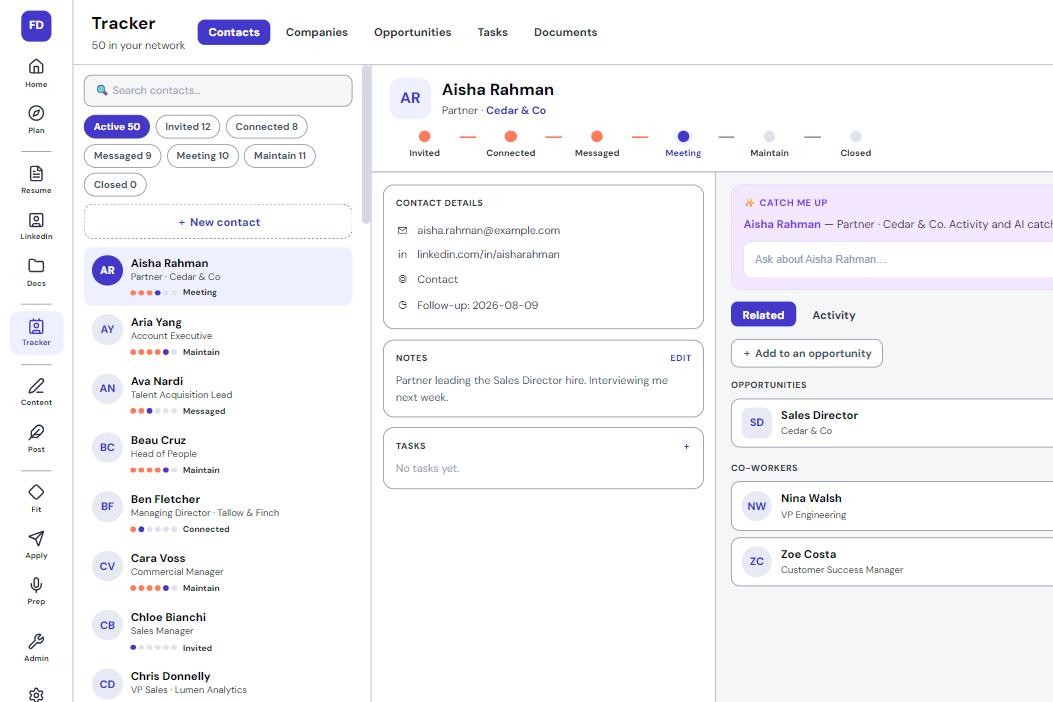
You write everyone down once, in one place, with the date you last spoke and what should happen next. Not in your head, not across three inboxes and a notebook. One list of people, one list of companies, one list of roles, each with a next step and a date.
Most opportunities are not lost to a no. They are lost to silence: a follow-up that never went out, a thank-you that slipped a week, an introduction offered and never chased. None of those are refusals. They are threads nobody was holding. With twenty contacts at different stages, holding all the threads in your head is not a matter of discipline. It simply does not work.
Once it is written down, the daily question gets easy. Who is due? Who has gone quiet too long? Which company have I not touched this month? The list answers, and you do the five.
What does thirty minutes a day get you?
More than a full day of unstructured effort, because it compounds. Thirty minutes is enough for a follow-up, one or two new messages and one small task. Do that most days and within a month you have been in touch with thirty or so people, and followed up with most of them. Some of those threads turn into conversations in two or three weeks, and some of those conversations turn into interviews six to ten weeks from the first message.
It also gives you your evenings back. The search has a shape, a start and an end each day, and the rest of the time is yours. People who run it that way tend to last longer, and a search that lasts is one that finishes.
Can you build this structure yourself?
Yes. A spreadsheet with a row per person and a next-action date will do the basics, and a calendar reminder each morning will make you look at it. The weak spot is the step between them: reading thirty rows and deciding which five matter today. That is exactly the decision that wears people down, so it is worth making it as small as possible, whether with a simple rule (oldest follow-up first) or a tool that sorts the list and leaves the choice with you.
Whichever you pick, keep the rule that matters most: one next step, a handful of things, and a finish line every day.
Where FutureDay fits
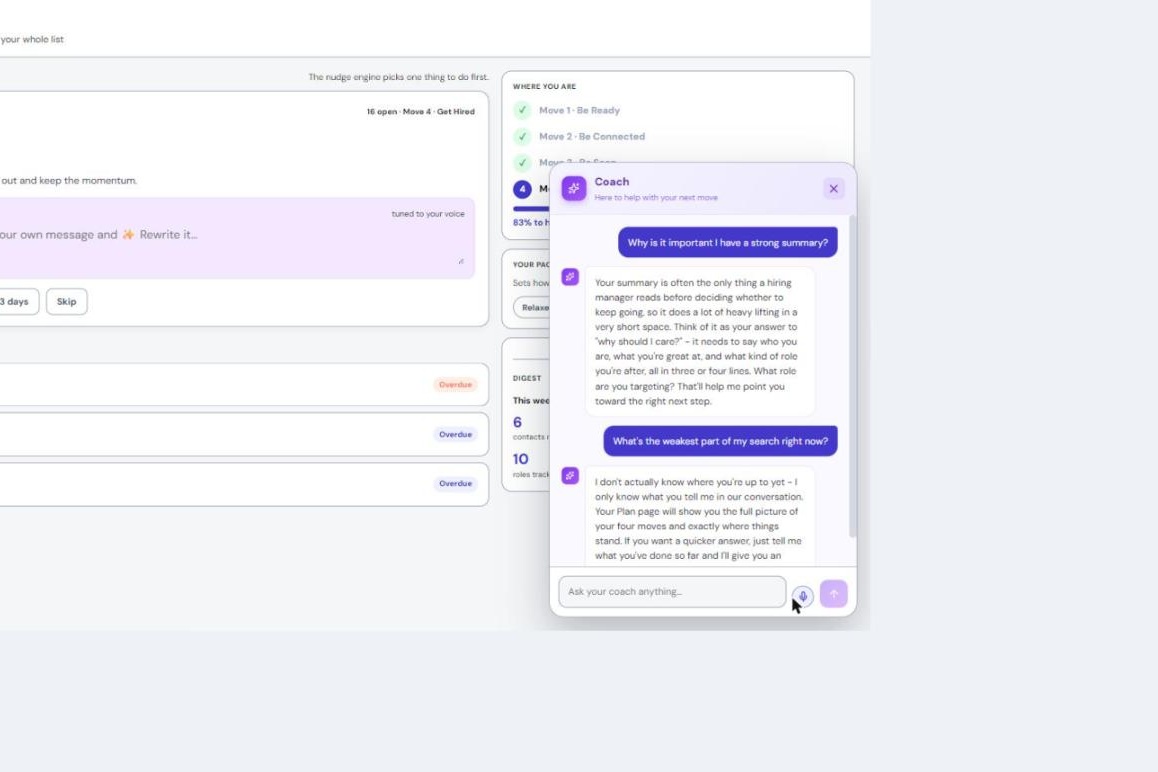
FutureDay gives a search the structure it lacks. Contacts, Target Companies and the Job Tracker hold every person, company and role, and each morning Home turns them into one next step and a short queue. The list doesn't refill: when it's done, you choose Do more or Rest for the day.
A search is tiring because it is almost all deciding, with no manager, deadlines or queue to shape the day.
That is why people default to applying: it feels like action even when it is the least effective thing on the list.
A good day is one next step and about five things, mostly people, with a clear finish line.
Write every contact, company and role down once with a next step and a date, so nobody is forgotten and the daily choice gets small.
 21 pages, a 15-minute read