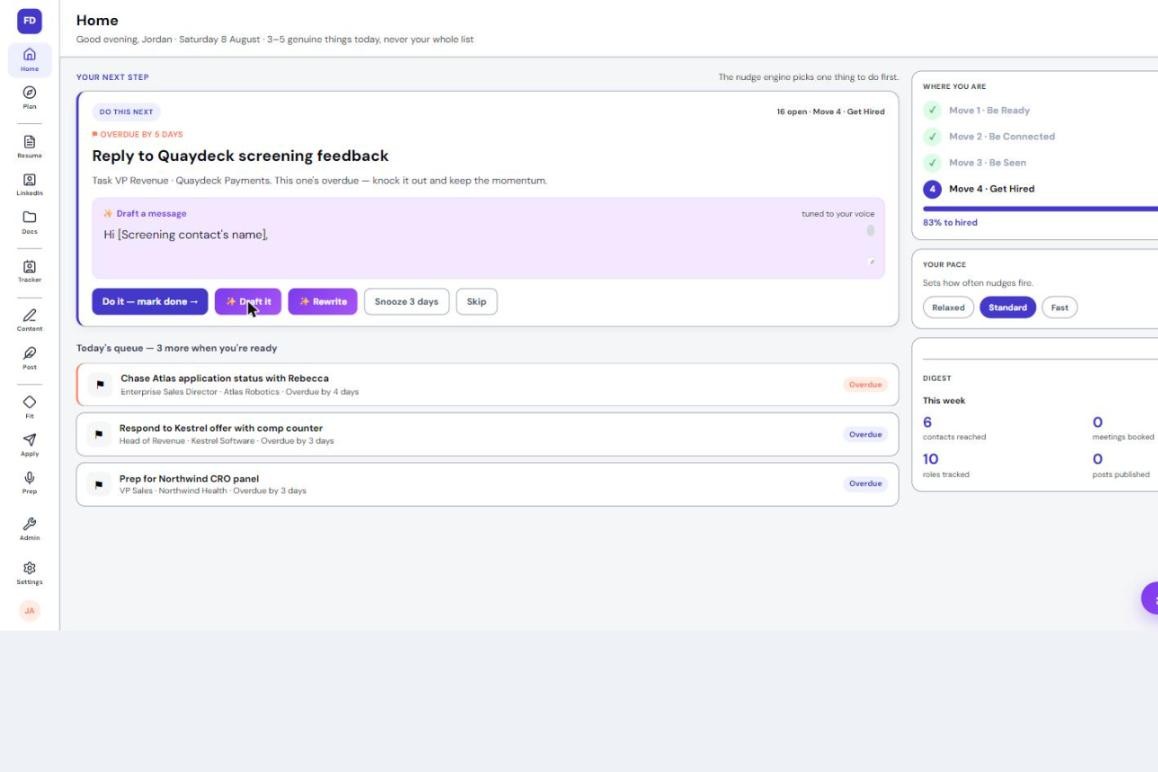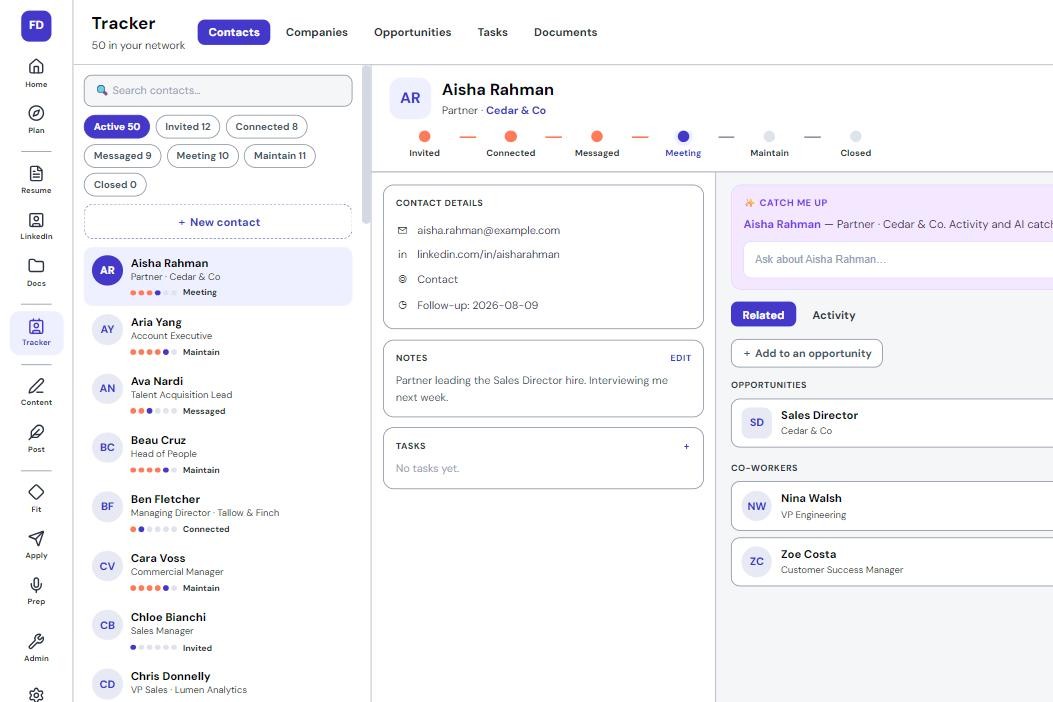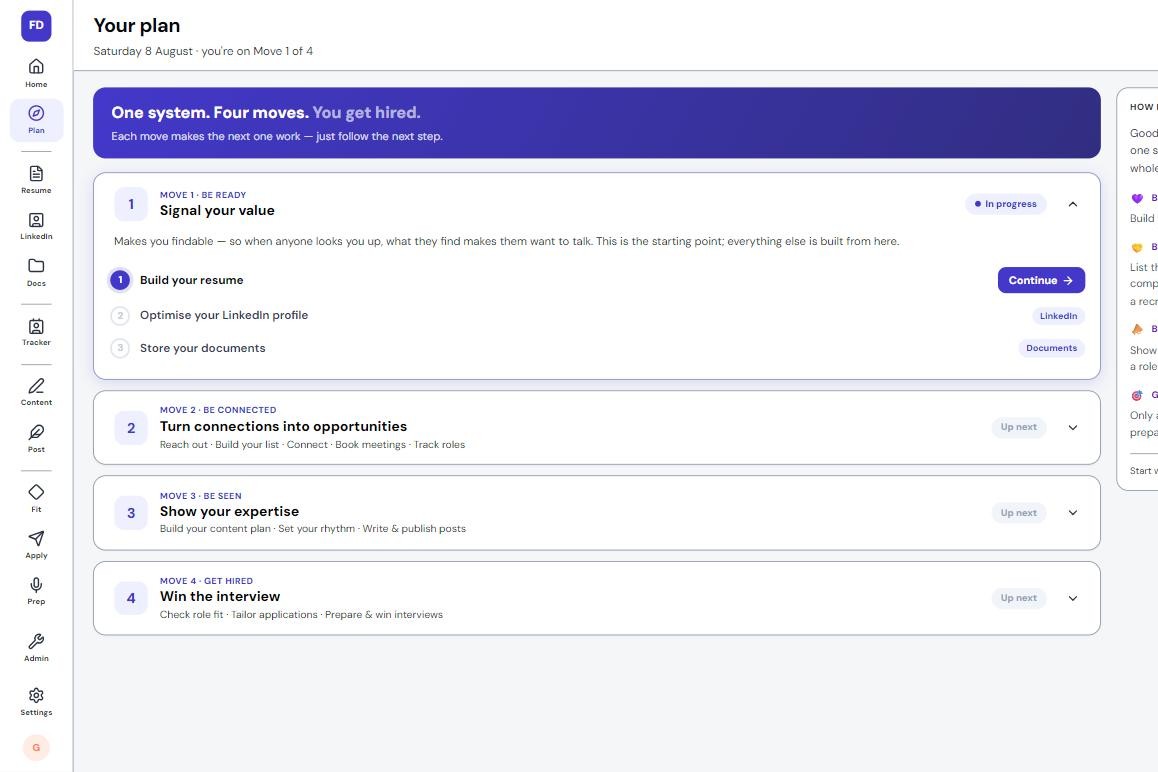
FutureDay's AI Coach isn't a chatbot pretending to know everything about you. Its main work happens quietly on your Plan page: a weekly digest built entirely from your real activity, telling you exactly what to do next and why. Ask it a direct question and it answers from what you've told it, and says so plainly when it doesn't know something yet, instead of guessing.
Why does most career advice feel like it's talking to someone else?
"Network more." "Tailor your resume." "Stay positive." The book behind FutureDay opens with the same complaint every job seeker already knows: generic advice that could apply to anyone doesn't tell you what to actually do this Tuesday. That's the reason it's built around four moves and thirteen chapters instead of one big list of tips, and why every single chapter ends the same way, with a section called "Your move," one small, specific action before you turn the page. Knowing the system in the abstract and knowing your own next move are two different problems.
What does generic advice actually cost you?
Without a real next move, momentum drifts toward whatever feels comfortable rather than what matters. Another pass on a resume that was already fine. Another LinkedIn tweak. Meanwhile the five contacts who are actually due for a check-in this week sit untouched, because nothing told you they were the priority. Advice that could apply to anyone rarely tells you what your own search needs today, so it's easy to stay busy without staying on track.
Why can't you just work this out yourself?
Partly because you're too close to your own search to see it clearly. Partly because sitting down each week to honestly total up what actually happened, what's overdue and what matters most in priority order is its own piece of work, and most people don't have the habit or the time. A generic AI chat tool doesn't solve this either. It knows nothing about your specific pipeline unless you paste it in fresh every time, and almost nobody does that consistently.
How the AI Coach actually guides your next move
Two things do the real work here, and they're deliberately different from each other. The first is the Weekly Digest on your Plan page, and it's genuinely built from your live data, not written to sound like it is. A real one opened with: "Hey Jordan, great to see you staying active this week. You've logged solid touchpoints and kept momentum on some key opportunities, so let's build on that." Underneath, three plain sections: This Week's Highlights ("You logged 6 touchpoints and moved 2 opportunities forward this week... 9 active applications in flight"), Worth a Look ("18 overdue follow-ups with your network contacts... 5 contacts due this week: Marcus Bell, Aisha Rahman, Tom Whitfield, Chris Donnelly and Hannah Pike"), and One Thing to Do Today, which named exactly one of those five contacts and said reach out now. The footer states it outright: based on your live data.
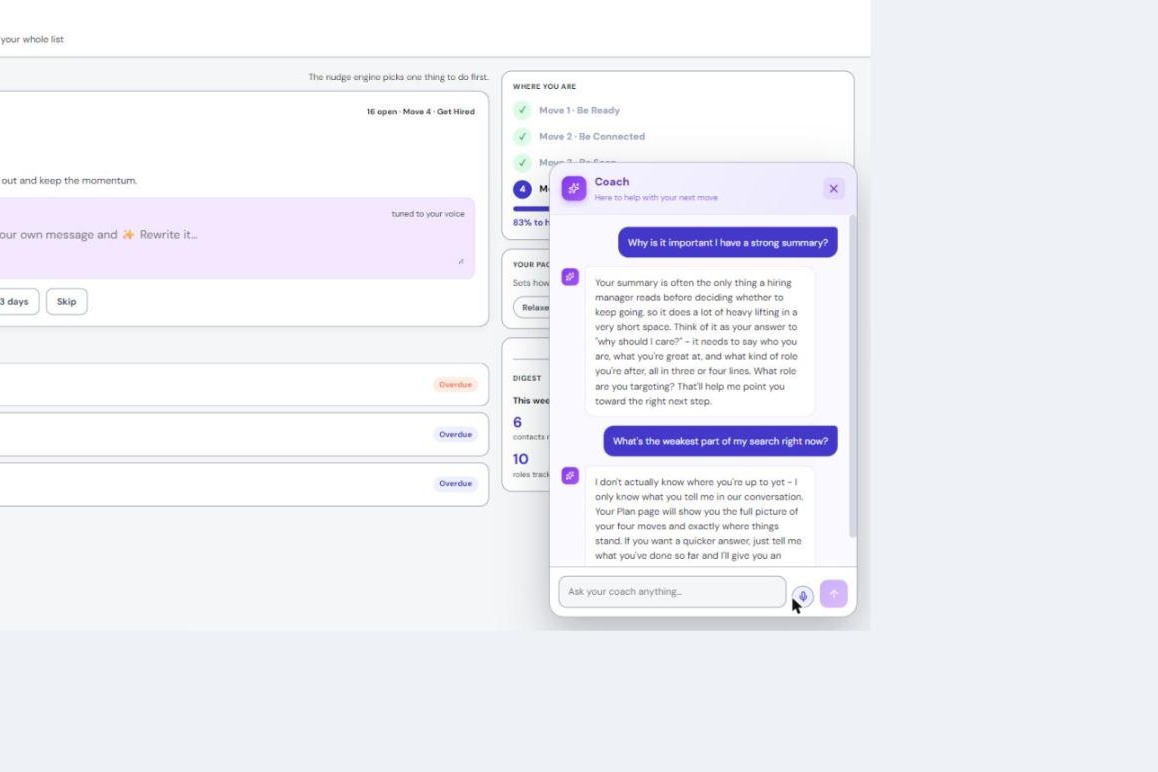
The second is Ask Your Coach, a chat panel available on every screen, aware of which page you're actually on. On a resume screen it suggests different questions than it does on a contact's page, where it prompts you to ask about that specific person. Asked a fair, sharp question, "What's the weakest part of my search right now?", a real conversation returned this, in full: "I don't actually know where you're up to yet, I only know what you tell me in our conversation. Your Plan page will show you the full picture of your four moves and exactly where things stand. If you want a quicker answer, just tell me what you've done so far and I'll give you an honest read." No invented weakness. No confident-sounding guess dressed up as insight. Just an honest answer, and a pointer to the one place that actually has the full picture.
Before: Generic advice that could apply to anyone: network more, keep applying, stay positive, with nothing to say about your actual pipeline.
After: "You've got 18 overdue follow-ups with your network contacts... pick one of those 5 contacts due this week and reach out today."
What changes when your coach tells the truth about what it knows?
You can actually act on what it tells you, because it isn't manufacturing certainty it doesn't have. The moment it does have real certainty, your own activity, logged this week, it says so plainly and hands you one specific thing to do, in the same spirit as the book's own "Your move," one small action, not a list. And when you ask it something it genuinely can't answer yet, it tells you that too, rather than inventing a plausible-sounding version of you to respond to.
Generic career advice doesn't tell you what your own search needs today, and most people don't have the time to work that out for themselves every week.
The Weekly Digest on your Plan page is built entirely from your real activity, and closes with one specific thing to do today.
Ask Your Coach is page-aware and answers from what you tell it. When it doesn't know something, it says so instead of guessing.
A coach that admits what it doesn't know is one you can actually trust on the things it does.
The best coach isn't the one with an answer for everything. It's the one you can actually believe when it gives you one.