Job Fit Checker scores any job ad against your actual resume across three questions: can you get it, are you genuinely strong for it, and is it actually right for you. It returns a score out of 100 with a plain verdict, your real strengths, and exactly where you fall short with a fix for each, so you know in under a minute whether a role is worth an evening of tailoring.
Most job searches lose hours to roles that were never winnable. Not because the person applying is weak, but because a title and a few overlapping words on a job ad feel close enough to apply, and the only way to find out otherwise used to be spending the evening on a tailored resume and cover letter and waiting weeks to hear nothing back.
Why do capable people keep applying to roles they won't get?
The book behind FutureDay calls this spray-and-pray, applying to everything vaguely relevant instead of judging each role honestly first. It's an easy trap, because a job ad rarely tells you outright that you're not a fit. It just uses familiar-sounding language, go-to-market, leadership, growth, words that mean something different depending on which function is actually hiring.
What does applying blind actually cost you?
Tailoring a resume and cover letter properly takes several hours, and forty applications adds up to roughly a full working month of hours across a search. The book is direct about the trade-off: every hour spent on a role you cannot win, or do not want, is an hour stolen from one you can and do. That's not a small inefficiency. It's the single biggest lever most people never pull, because they never stop to ask whether a role clears the gate before they start writing.
Why is this hard to judge about your own application?
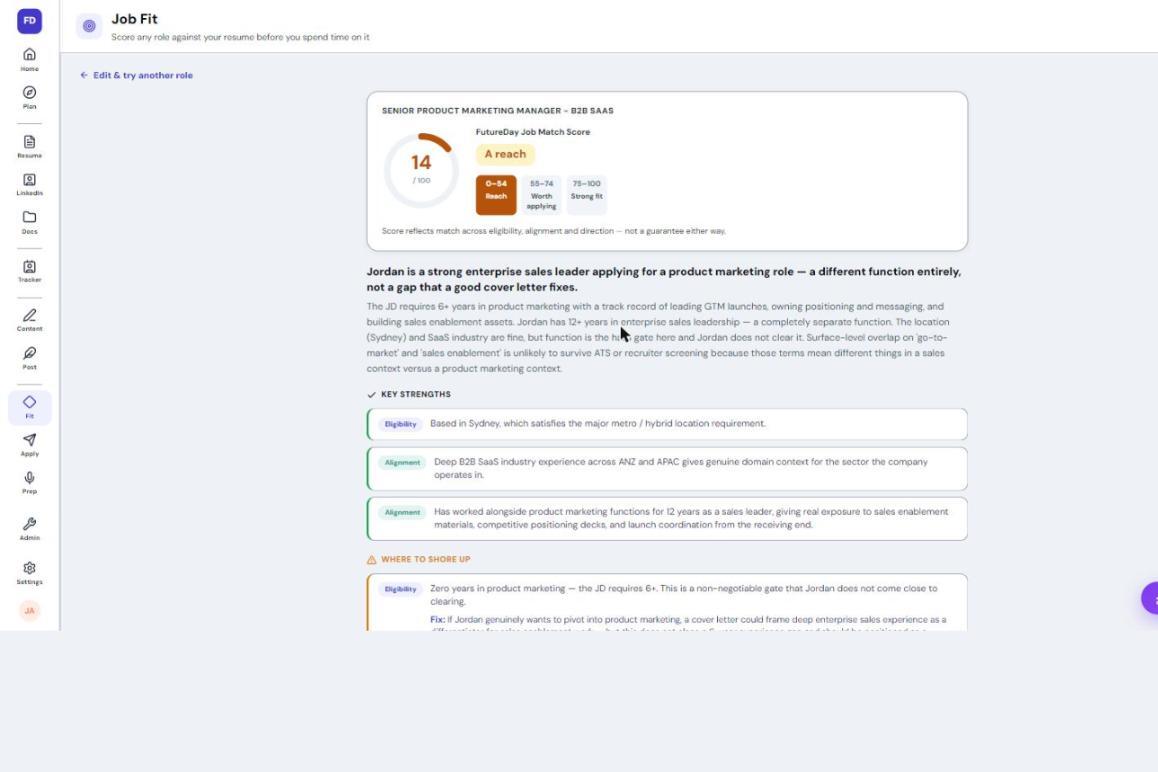
Because you're reading your own resume with the most charitable eyes in the room. A real test run through the checker makes the pattern obvious: a resume built around twelve years of enterprise sales leadership, scored against a senior product marketing role. The two share real surface language, go-to-market, sales enablement, cross-functional work, so on paper the overlap looks promising. The checker's verdict was blunt: those terms mean different things in a sales context than in a product marketing one, and the surface overlap was unlikely to survive an ATS or a recruiter screen. That's exactly the kind of gap almost impossible to see about your own application, because the words genuinely do appear on both sides, and nobody reads their own resume looking for reasons to reject it.
How does the Job Fit Checker solve it?
It scores against the same three checks the book teaches for judging whether a role is worth your time. Eligibility asks whether you can actually apply at all, seniority, years required, location, must-have certifications, the hard gates a role either has or doesn't. Alignment asks how strong a candidate you genuinely are, industry match, core skills, scope, track record, not just whether you clear the door. Direction asks whether the role is actually right for you, checked against where you've said you're headed, not just whether you could technically do the job.
You paste or upload the job ad and add anything worth weighing, open to relocating, deliberately stretching for this one, and it works through three visible steps: reading the role and its requirements, matching them against your actual resume, then scoring eligibility, alignment and direction. The result is a score out of 100 against three named bands, 0 to 54 is a reach, 55 to 74 is worth applying, 75 to 100 is a strong fit, alongside a plain-English verdict that says exactly what's going on, not just a number. In the test run, 14 out of 100, a reach, with the reason stated in the first line, a strong candidate for a different function entirely, not a gap a good cover letter closes.
Underneath that sits the actual reasoning, not just the score. A Key Strengths list shows what genuinely counts in your favour, tagged by which of the three questions it answers. A Where to Shore Up list does the same for the gaps, and each one carries a concrete fix, reframe this experience honestly, surface this specific evidence, update your summary if this is a genuine pivot, not just a flag with nothing to do about it.
None of it tells you not to apply. The closing note says as much directly: there are plenty of good reasons to apply to a reach role anyway, a referral, a deliberate stretch, genuine interest in the company, and the decision stays yours. A "Build it anyway" button carries the same fit notes straight into the resume and cover letter tools, so if you do go ahead, you're doing it with your eyes open instead of guessing, not starting from a blank page pretending the gaps don't exist.
Before: The title and a few familiar words look close enough, so you spend an evening tailoring a resume and a cover letter before finding out weeks later you were never in the running.
After: In under a minute the score comes back at 14 out of 100, a reach, with the exact reason stated plainly, zero years in the function the role is actually hiring for, no matter how much adjacent language the resume shares with the ad.
What changes once you know before you apply?
The hours that used to go into long-shot applications move to the roles that actually clear the gate. A reach score isn't a wall either. It's information, exactly what the method calls the third question almost everyone skips, and the same notes that explain a low score feed straight into a stronger, more honest application if the role is still worth pursuing. The score reflects a match, the app is careful to say, not a guarantee either way, which is the right amount of confidence for a tool that's meant to sharpen your judgement, not replace it.
Spray-and-pray applying costs real hours, roughly a month's worth across forty applications tailored properly.
The Job Fit Checker scores any role against your resume across eligibility, alignment and direction, the book's own three-question test, built into software.
A score out of 100 comes with a plain verdict, real strengths and specific gaps, each with a fix, not just a number.
Applying to a reach role is still your call. The score just makes sure it's an informed one.
Every hour spent on a role you cannot win, or do not want, is an hour stolen from one you can and do. Focus is not a limitation. It's the whole advantage.