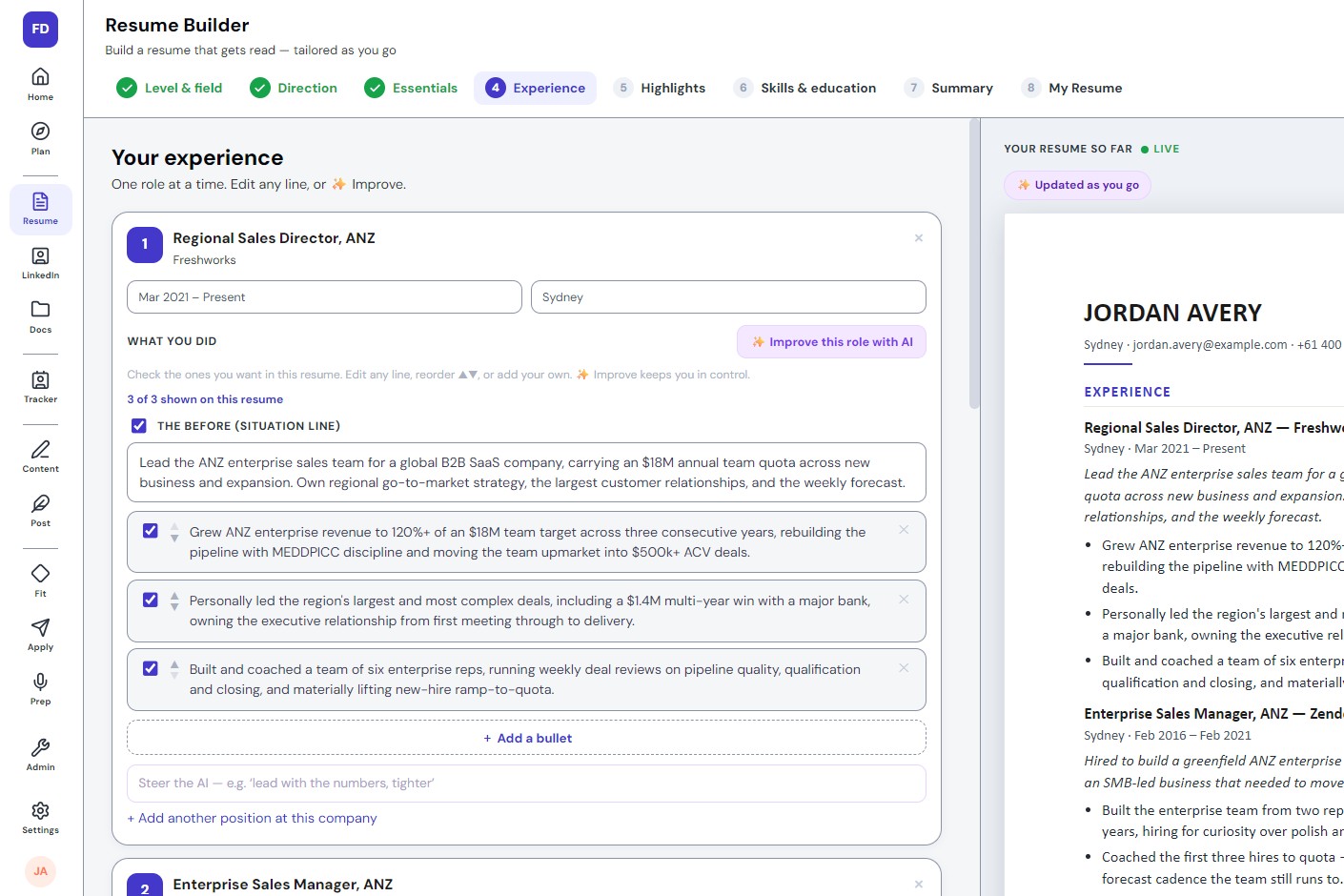
Most resume bullets describe what someone was responsible for instead of what they actually did, which is the single most common thing quietly killing an otherwise decent resume. The fix is one formula, repeated on every line that matters: a strong verb, what you did, how you did it, and a measurable result. It sounds small. It changes how every line reads.
Read almost any resume and you'll find the same sentence shape repeated four or five times: "Responsible for X." It's not wrong, exactly, it's just answering the wrong question. A job description tells a reader what the role was supposed to do. A resume needs to tell them what actually happened when this specific person did it.
Why does "responsible for" kill a resume line?
Because it describes the job, not the person in it. Ten different people could have held that exact title with that exact duty, and "responsible for managing client accounts" would be equally true, and equally useless, for all ten of them. It answers "what was the job," when the only question that actually matters to a reader is "what did you do with it."
What's the actual formula?
Four parts, in order: a strong action verb ("built," "led," "cut," "grew," "negotiated," not "helped" or "assisted"), what you did, how you did it, and a measurable result. Not every bullet will hit all four cleanly, but the strongest ones almost always do, and the formula is the fastest way to catch a bullet that's still describing a duty instead of an outcome.
Before: "Responsible for managing a portfolio of client projects and ensuring deadlines were met."
After: "Managed a $4M portfolio of 12 concurrent client projects, restructuring the handoff between design and delivery to cut average turnaround from 14 weeks to 9."
What if you genuinely don't have a number?
Most roles have one somewhere, even outside sales and finance: team size, budget, project count, percentage improvement, time saved, or simple frequency ("weekly," "across 6 markets") all count as a number worth including. When a true number genuinely doesn't exist, scope still does. "The only person managing this," "the first to do this at the company," "across every regional office" all say something a plain duty statement doesn't. What matters is specificity; a number is just the fastest way to get there.
A customer support lead with no sales figures to point to can still say "handled escalations for a 40-person team across three time zones, cutting average resolution time from two days to six hours" instead of "responsible for managing escalations." Nothing there is a revenue number. It's still concrete enough that a reader can picture the actual job, which a duty statement never lets them do.
Why does one rewritten line change the whole resume?
Because reading a resume is pattern matching, not line-by-line evaluation. A recruiter who hits two or three achievement-shaped bullets in a row starts reading the rest of the page differently, expecting more of the same, and starts to believe the claims in the summary and headline too. The reverse is also true: a page of duty statements makes even a genuinely strong headline read as generic, because nothing underneath it has backed it up yet.
Does every single bullet need to hit the formula?
No, and trying to force it everywhere usually backfires. An early or minor role can stay short and duty-shaped if it isn't doing much work in the argument. Save the full formula for the two or three roles that are actually carrying the case for this application. A resume where every line is straining for a stat starts to read as exhausting rather than convincing.
Why do duty statements survive so long on resumes that are otherwise strong?
Because they're the easiest thing to write under deadline. When an application is due tonight, describing what the role covered is a five-minute task; working out what actually changed because of the work takes longer, because it means going back through a year or two of results to find the number. Duty statements aren't usually a skill gap. They're a time-pressure default that never gets revisited once the resume is finished and filed away.
What's the fastest way to check a whole resume against this?
Read only the first word of every bullet, down the page. A resume dominated by "responsible for," "helped," "assisted," and "involved in" is a resume built from duties. One that opens with "built," "led," "cut," "grew," and "negotiated" is already halfway to reading like a case for hiring rather than a record of attendance. That one scan takes under a minute and finds most of the weak lines at once.
It also works as a quick before-you-send check on a specific application, not just a full audit. Scroll straight down the left edge of the bullet list; if three or four verbs in a row are weak ones, that's exactly where to spend the last ten minutes before submitting, rather than re-reading the whole document top to bottom looking for something to fix.
"Responsible for" describes the job. An achievement-shaped bullet describes what this specific person actually did with it.
The formula: a strong verb, what you did, how you did it, and a measurable result, in that order.
No true number available doesn't mean no specifics available; scope and frequency still beat a vague duty statement.
A few strong achievement bullets change how a reader treats the rest of the page, including the summary and headline above them.