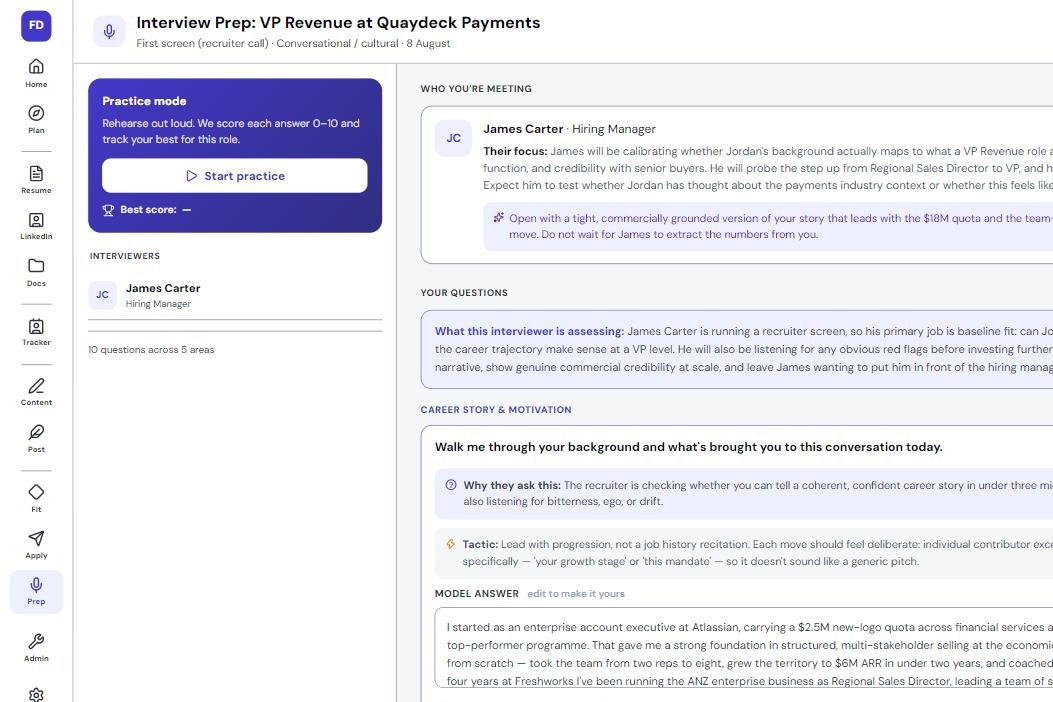
"Tell me about yourself" isn't an invitation to recap your entire resume out loud. It's asking for a career story, told in under three minutes, that covers where you started, the deliberate moves that built your expertise, the achievement that shows what you're capable of, and why this specific role is the right next step. Prepared in advance, it sets the tone for the whole interview.
Almost every interview opens with some version of "tell me about yourself" or "walk me through your background," and almost every candidate who hasn't prepared for it wastes the best opening minutes of the conversation improvising a chronological resume recap that goes nowhere in particular.
Why does this question matter more than it seems like it should?
Because it's usually the first real signal an interviewer gets about how someone thinks, not just what they've done. A rambling, unstructured answer suggests disorganized thinking before a single technical question has even been asked. A tight, purposeful answer does the opposite: it signals clarity, and it hands the interviewer a frame for understanding everything else that gets discussed afterward. Preparation here isn't about sounding rehearsed, it's about controlling the narrative from the first minute instead of leaving it to whatever comes out under pressure.
What actually goes into a career story that works?
Four parts, in order. Where you started, briefly, enough to establish context without dwelling. The deliberate moves that built your expertise, framed as choices you made on purpose, not things that happened to you. The single achievement that best shows what you're capable of at your best, specific and quantified where possible. And why this particular role is the right next step, connecting everything that came before to the job actually being discussed.
The fourth part is the one people skip most often, and it's the one that makes the whole answer land. A career story that ends on the achievement and stops leaves the interviewer to guess why you're sitting in the room. A career story that closes by connecting your background directly to this role removes that guesswork and does some of the interviewer's thinking for them.
Before: "So I started out in customer support at my first company, then moved into account management for a couple of years, then I was promoted to team lead, and now I'm a senior account manager handling our biggest clients. I've been there about six years total."
After: "I started in customer support because I wanted to understand what actually frustrates clients before I ever tried to sell to them. That instinct led me into account management, and three years ago I asked to take over our two highest-risk accounts specifically, both flagged for churn. I rebuilt the relationship on both, and they're now our two largest renewals, worth $1.1M combined. I'm looking at this role because it's the same kind of high-stakes account work, at a scale I haven't had the chance to work at yet."
How long should this actually take to say out loud?
Under three minutes, and closer to ninety seconds is often stronger. Longer than that and the interviewer's attention starts to drift, and the story stops feeling like a tight answer and starts feeling like the interview has been quietly hijacked. A useful test while preparing: say the answer out loud, timed, more than once. The first attempt almost always runs long, because everything feels equally important when it's still in your head. The second and third pass are where the real trimming happens, cutting to what actually needs to be there.
Does the story need to change for every interview?
The core shape stays the same, but the fourth part, why this role, needs to be genuinely specific to the company and job in front of you, not a generic closing line reused everywhere. A career story that ends with a vague "and I think this would be a great next step" undoes a lot of the credibility the first three parts just built. The strongest version names something real and specific about the role or company that connects directly to the achievement just described.
What if the honest version of your background isn't a straight line?
Most real careers aren't straight lines, and trying to force one usually reads as evasive rather than impressive. A career story can include a pivot, a gap, or a step sideways and still work, as long as it's framed as a deliberate choice with a reason behind it rather than something that just happened. "I moved out of management for eighteen months to rebuild deep technical skills I knew I'd need for the next stage" is a stronger, more credible line than pretending the sideways move never happened.
The same principle applies to a gap between roles. Naming it plainly, in one sentence, with whatever genuine reason sits behind it, closes the question before the interviewer has to ask it themselves. Leaving it unaddressed doesn't make it invisible, it just means the interviewer fills in the blank on their own, usually with a less generous guess than the truth would have been.
"Tell me about yourself" is asking for a structured career story, not a chronological resume recap.
The four parts are: where you started, the deliberate moves that built your expertise, your strongest achievement, and why this specific role is the right next step.
Keep it under three minutes, closer to ninety seconds where possible, and rehearse it out loud more than once before the interview.
A pivot or gap doesn't weaken the story if it's framed as a deliberate choice rather than something left unexplained.