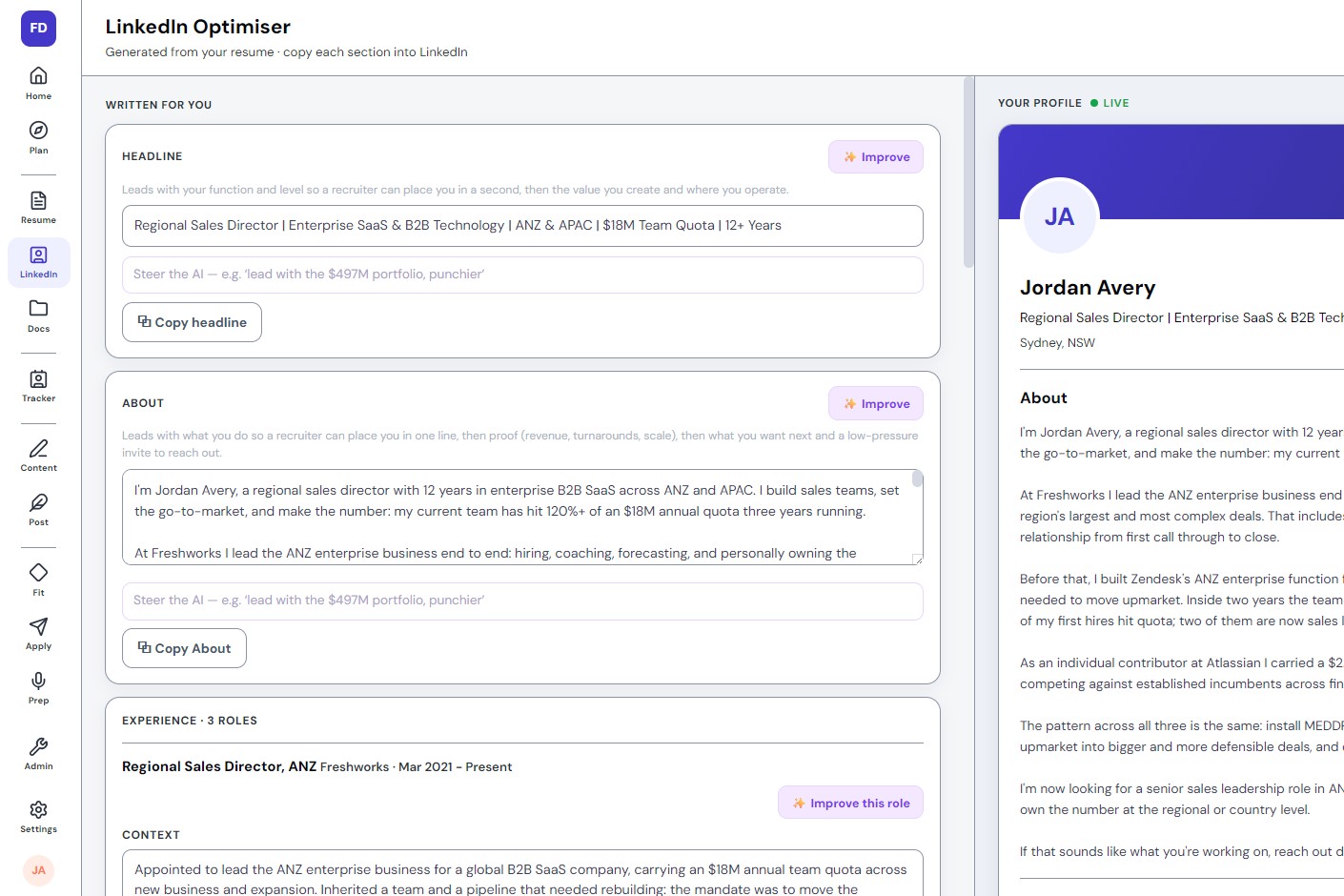
A LinkedIn profile that isn't getting interviews usually isn't invisible. It's being found, and it's failing in the roughly eight seconds after someone actually lands on it. That gap between what a profile means to say and what a stranger actually reads is the signal problem, and it's almost impossible to see from the inside, because the person who built the profile already knows the missing context.
"My profile is finished and nothing is happening" is one of the most common, most confusing experiences in a job search. Every field is filled in. The photo is decent. The headline exists. And still, silence. The instinct is to assume the profile isn't being seen at all. Usually, it is. The problem is what happens in the next eight seconds, a window most people never think to examine because their own attention span isn't part of the problem they're trying to solve.
What is the signal problem, exactly?
It's the gap between what a profile is trying to communicate and what a stranger actually receives in the few seconds they spend deciding whether to keep reading. A profile can be technically complete and still fail here, because completeness and communication aren't the same test. One checks whether the fields are filled in. The other checks whether a stranger, with none of the context the owner carries in their head, understands what they're looking at fast enough to act on it.
What is a visitor actually deciding in those first few seconds?
Four questions, running in the background, usually without the visitor consciously naming any of them. Can this person actually do what I need done? Have they done it before, at the level I need? Is this person right for my specific situation, not just generically qualified? And once they've decided yes to the first three, what do I do next; is there an obvious way to act on this?
A profile only needs to fail one of these to lose the visitor. Someone can be exactly right for a role and still lose the moment if the answer to any one of the four questions isn't obvious inside that first short window.
Why can't you see this gap in your own profile?
Because the person who wrote it already knows all the missing context, and that knowledge makes the gap invisible. Reading your own headline, you already know what you mean by it. A stranger doesn't get that benefit. They read exactly what's on the page, once, quickly, with none of the backstory filled in automatically the way it is for the person who wrote it. This is the same reason writers need editors and speakers need rehearsal audiences: the gap between intent and reception is genuinely hard to spot from inside your own head.
It shows up in a specific, testable way. Ask someone who's never worked with you to read your profile for eight seconds, then explain back what you do and who you do it for. The gap between what they say and what you meant is the signal problem, made visible for the first time, and it's usually larger than expected even for people who consider their own writing clear.
What does a profile that closes the gap actually do differently?
It trades a general claim for a specific one, everywhere it can. A general claim asks the reader to take the writer's word for it. A specific one lets the reader check it themselves, which is a fundamentally easier thing to believe.
Before: "Experienced HR leader passionate about people, culture and driving positive change."
After: "I've rebuilt HR from a compliance function into a genuine talent engine inside three companies scaling past 500 people, most recently cutting time-to-hire by 40% in eighteen months."
The first line answers none of the four questions a visitor is actually asking. The second answers all of them inside two sentences: what this person does, that they've done it before at a specific scale, evidence it's transferable across situations, and a result concrete enough to act on. Nothing about the person changed between the two versions. What changed is whether a stranger reading it for eight seconds actually receives the signal being sent.
What changes once the signal problem is fixed?
Nothing about the underlying career changes, but what happens after someone lands on the profile does. Profile views start converting into actual contact instead of silently bouncing. The people who do reach out ask sharper, more specific questions instead of "so, tell me about your background," because the profile already answered the basic ones. And crucially, the fix rarely requires more content. It usually requires the same information, said with enough specificity that a stranger doesn't have to guess at what's being claimed, which is often less writing, not more.
A profile that isn't getting interviews is usually being found, not ignored. It's failing in the roughly eight seconds after someone lands on it, the signal problem.
Every visitor is running four questions in the background: can you do this, have you done it before at this level, are you right for my situation, and what do I do next.
You can't easily see this gap in your own profile, because you already supply the missing context automatically when you read it.
The fix is specificity, not more content: trade general claims for checkable ones, everywhere the profile currently asks a reader to take something on faith.