Every company has two ways in. The front door is the public job posting: crowded, slow, and often not even real. The side door is someone inside who already knows your name. Most job seekers only ever try the front door, and mass-applying through it has quietly become one of the worst uses of your time. This piece explains what the hidden job market is, why the side door works better, and how to work both doors instead of knocking harder on one.
Picture two doors into the same building. One is the front entrance everyone can see: glass doors, a queue, a sign-in sheet. The other is around the side, unmarked, and open only to people who already know it's there. Most job searches only ever try the first door, then wonder why the queue never seems to move.
Why does trying harder at the front door keep failing?
The instinct, when applications go nowhere, is to apply to more of them. More postings, more platforms, more evenings spent tailoring a resume for a job you'll never hear back from. It feels like effort. It isn't fixing anything, because the front door was never the whole entrance to begin with.
A public posting goes up, and within days it can draw hundreds of applications. Most of those applicants never hear back, not because they weren't good enough, but because a handful of candidates get a real look and the rest sit in a queue that nobody works all the way through.
Greenhouse counted 244 applications per job in 2025, up from 116 in 2022, and about 3 in 10 jobs closed that year without anyone hired. Ashby's data shows it now takes close to 300 applications to make one hire. Apply to enough of these and something predictable happens: silence, over and over, with no explanation attached to any of it.
Two things are driving it at once. Volume has gone up: AI-assisted applications make it easy to apply to dozens of roles in an afternoon, so every posting draws a larger pool than it used to. And on the other side, tracking software filters that pool before a human opens most of the applications, screening on exact keyword matches that reward the applicants who happen to phrase things the way the system expects, not necessarily the strongest candidates.
You are not being ignored because you are not good enough. You are being ignored because you are playing a game by rules that no longer apply.
Enough unexplained silence and most people start to believe the problem is them. Psychologists have a name for this: learned helplessness, the state where repeated effort with no visible result teaches you that nothing you do matters. It shows up in job searches as a specific, corrosive thought: maybe I'm just not good enough anymore. The actual lesson is different. It isn't that effort doesn't work. It's that this particular door was never going to open as often as the number of people knocking on it would suggest, no matter how well you knock.
Is mass applying for jobs a waste of time?
When it is the whole plan, mostly yes. Tailoring a resume and cover letter properly, not just swapping a company name, takes several hours per application if it's done with any care. Forty applications is close to a full working month of hours, spent on documents that mostly disappear into a queue with no way to know if they were even read. That's the real cost of relying on the front door alone: low odds, bought with hours that could have gone somewhere with a better return. And the hours are only half of it: a search that runs long costs more than time, and most of that bill never shows up in a spreadsheet.
None of this means applications are pointless. A posting is still a useful signal: it tells you a company has a real need right now. What it shouldn't be is the only move. Read it for what it tells you about the company's needs, then go and find the person behind it.
What is the hidden job market?
The side door is what people mean by the hidden, or off-market, job market: the large amount of hiring that happens through visibility, relationships and direct approach rather than through the apply button. It isn't a secret list of jobs somewhere. It's a different mechanism for the same outcome, someone getting hired, and it runs on people who already trust each other rather than a resume competing cold against a couple of hundred others.
Referrals make the size of this door hard to ignore. In Ashby's study of 38 million applications, 40 percent of referred applicants got an interview, against 3 percent of people who applied cold. Nearly everyone else came in through the front door.
Why does the side door work better?
A cold application asks a stranger to take a risk on a resume. A warm approach asks a stranger to trust a person they already trust. Those are structurally different decisions, and the second one is a much easier yes. The resume in the pile is being screened for reasons to say no. The person a colleague vouches for is being considered for reasons to say yes. Same candidate, same qualifications, completely different starting position.
This is the whole reason the search now rewards the best-positioned over the best-qualified. Being right for a role was never the only variable. Being in front of the right person, at the right moment, through someone they already trust, changes the odds more than another rewritten bullet point ever will. None of this means qualifications stop mattering. It means qualifications alone were never going to be enough to get you seen.
Take Bill, from the book behind the Off-Market Method, “Stop Applying, Start Getting Hired”. He spent months applying the traditional way after being laid off: twenty to forty applications, almost total silence, the dread of the same question at dinner every night. What moved things was going to people who already knew him. One conversation with a former colleague turned into an introduction, and six weeks later he had an offer for a role that had never been advertised at all. Nothing about his resume changed in that window. What changed was which door he used.
What does working both doors look like?
Treat a job posting as a starting point, not the finish line: who do you know at that company, or one step removed from it? A short, genuine message to that person, framed as wanting to learn rather than asking for a favour, does more for your odds than another perfectly worded cover letter sent into a queue. If there's no route in through someone you know, a cold application is still worth sending, as one move among several instead of the whole strategy.
Front door only: Forty applications sent through job boards over six weeks. Three responses, all automated rejections. No sense of what's going wrong, because there's no feedback loop, just silence.
Front door plus side door: The same six weeks spent building a target list of twenty companies and reaching out directly to a dozen people already inside them. A handful of real conversations, one warm introduction that turns into an interview for a role that was never advertised.
There are two ways to run a search from here. You can keep refreshing job boards and hope the next application is the one that lands. Or you can build: decide who you want to work for, find the people already inside, and put yourself in front of them on purpose. The front door isn't going away, and it's still worth using when it's genuinely open. It was just never meant to be the whole search.
Where FutureDay fits
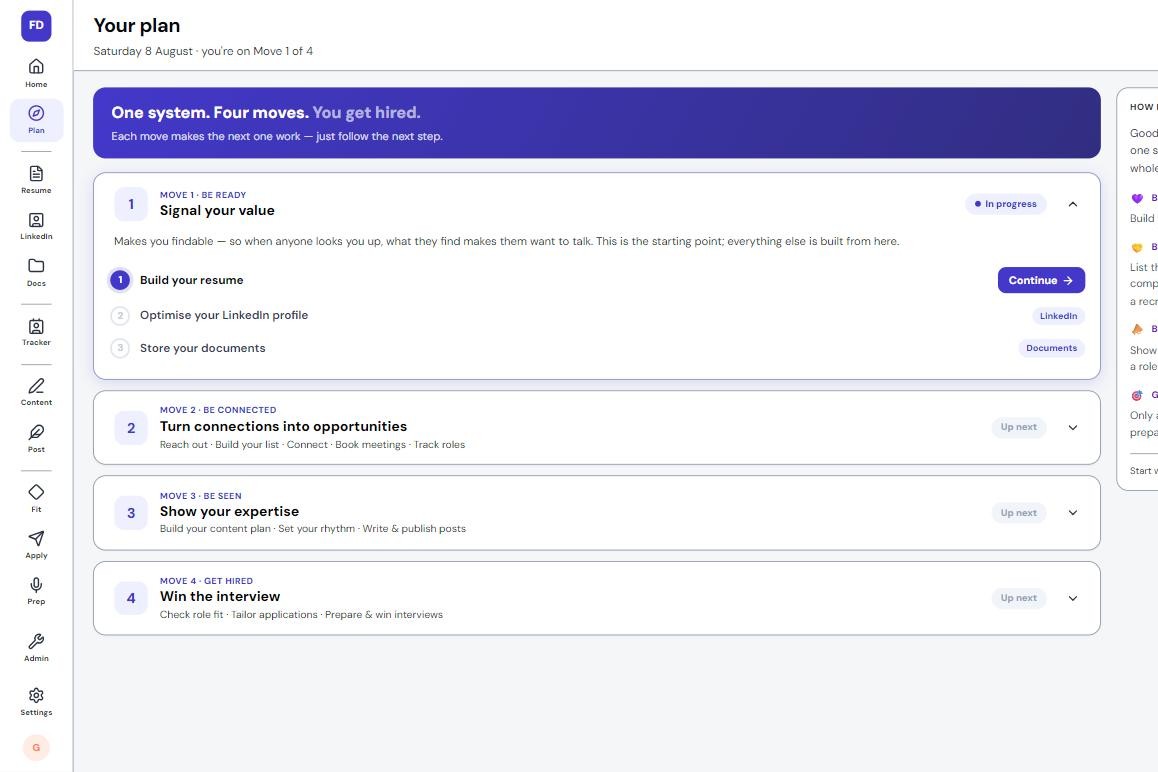
FutureDay is built for the side door. Contacts and Target Companies hold the people you know and the companies you'd want to work for, and each morning Home gives you the next person to reach, with the message ready to copy. You send it yourself. When a role does come up, the Job Fit Check tells you in about a minute whether it's worth the evening.
Every company has a front door, the public posting, and a side door: the hidden job market, hiring that happens through people who already know and trust someone.
The front door isn't failing you because you're doing it wrong. It's structurally crowded: 244 applications per job in 2025, and about 3 in 10 jobs closed without anyone hired (Greenhouse).
Mass-applying alone buys low odds with a lot of hours: forty careful applications is close to a working month.
In Ashby's data, 40% of referred applicants got an interview, against 3% who applied cold, which is the clearest evidence the side door works.
Use a posting as a starting point for a direct approach. The fix isn't applying harder. It's building relationships with the people already inside the companies you want to work for, on purpose, before a role is ever posted.
 21 pages, a 15-minute read