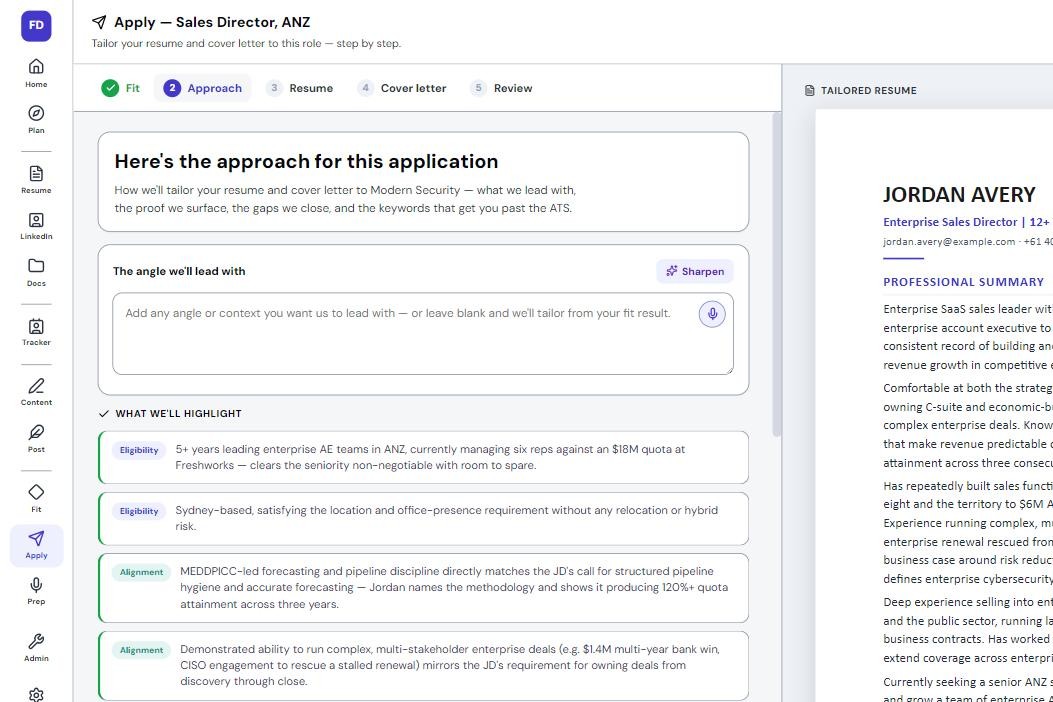
Tailoring a resume for a specific role doesn't mean rewriting it from scratch each time. It means three deliberate moves on a strong base document: mirror the role's actual language, lead with the proof that's most relevant to this job, and cut what doesn't serve it. Done right, tailoring takes minutes, not hours, and the reader can tell the difference in seconds.
A generic resume and a genuinely tailored one can contain almost the same facts and still land completely differently. The reader can tell which is which almost immediately, not because one is dishonest and the other isn't, but because one was clearly built for this role and the other was built for any role.
What does "tailoring" actually mean, if it's not rewriting?
Rewriting from scratch for every application is exactly the trap that makes tailoring feel too expensive to bother with, which is why most people either skip it entirely or do a token pass, swapping the company name and calling it done. Real tailoring works differently: start from one strong base resume, then make three specific, deliberate moves on top of it for each role. It's editing with intent, not reconstruction.
What's the first move?
Mirror the language of the role. Job descriptions use specific words for a reason, and matching that language, honestly, not by stuffing keywords, helps both the ATS software scanning the resume and the human reader who wrote the posting recognize the fit faster. If a posting repeatedly says "stakeholder management" and your resume says "client relations" for the same underlying work, that's a mismatch worth closing, not because the meaning is different, but because the reader is scanning for their own words, not a synonym.
What's the second move?
Lead with the most relevant proof. A single base resume usually has several strong achievements sitting in it, but they're rarely equally relevant to every role. For a role focused on cost reduction, the achievement about cutting a budget by 18% belongs near the top. For a role focused on growth, an achievement about expanding into a new market belongs there instead. The facts don't change, only which ones get put in front of the reader first, because attention on a resume is heaviest in the first few lines and drops off fast after that.
Untailored (sent to both roles): "Led a cross-functional team of 12, managing a $2.4M annual budget while overseeing product launches and stakeholder communications across three markets."
Tailored for an operations role: "Cut departmental overhead 18% by restructuring vendor contracts and consolidating a $2.4M budget across three markets, without reducing team headcount."
Tailored for a growth role: "Led product launches into two new markets in 14 months, building the go-to-market plan and cross-functional team of 12 that took the first market from zero to $600k in year-one revenue."
What's the third move?
Cut what doesn't serve this role. A base resume built over a full career often has detail that's genuinely impressive but irrelevant to the specific job in front of the reader. Tailoring means trimming that detail down, not because it isn't true or interesting, but because every line that doesn't support this specific application is quietly diluting the lines that do. A resume that includes everything argues for nothing in particular. A resume that includes only what matters for this role argues clearly for one thing.
Doesn't this take just as long as writing a new resume each time?
Not once the base document is solid. The time-consuming part of tailoring isn't the three moves themselves, each takes a few minutes on a resume that's already well-structured. The time sink is starting from a weak base and trying to fix structural problems, formula-less bullets, no clear headline, disorganized sections, while also trying to tailor for a specific role at the same time. Get the base resume right once, built around a clear headline, achievement-driven bullets, and a summary that states who you are and what you deliver, and tailoring against it for each new role becomes a fast, repeatable edit rather than a rebuild.
There's a practical test for whether the base resume is actually solid enough to support this. Open it and time how long the three moves take against a real posting. If mirroring the language, reordering the proof, and trimming what doesn't fit takes ten or fifteen minutes, the base is doing its job. If it takes an hour and still feels like patchwork, the problem isn't the tailoring process, it's that the base resume needs fixing first.
How can you tell if a resume has actually been tailored or just lightly touched?
Cover the company name at the top and read the resume as if it were sent somewhere else entirely. If nothing about the content, the ordering, or the emphasis would need to change for a different but similar role, it probably wasn't tailored, it was just personalized with a name swap. A genuinely tailored resume reads like it could only have been built with this specific posting open in another tab.
Tailoring is three deliberate moves on a strong base resume, not a rewrite from scratch for every application.
Mirror the role's actual language, lead with the proof most relevant to this specific job, and cut what doesn't serve it.
The same underlying achievements can be reordered and reworded to argue for very different roles without changing the facts.
A solid base resume makes tailoring a fast edit; a weak one makes every application feel like starting over.