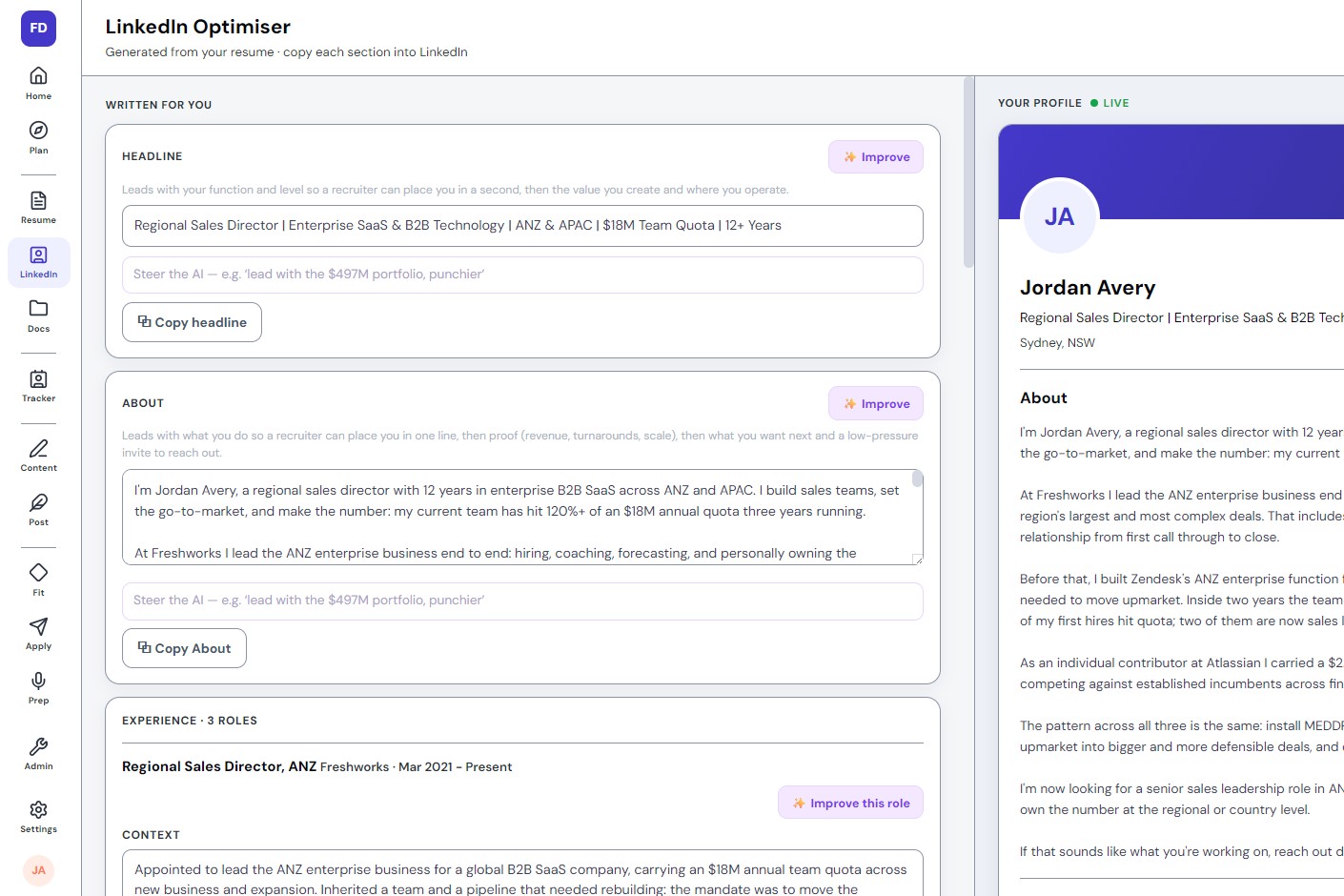
A resume and a LinkedIn profile should state the same facts, same dates, same titles, same numbers, but they're read by different people, at different moments, for different reasons. That means the writing shouldn't match. Copying one straight into the other is one of the most common resume and profile mistakes, and it quietly weakens both.
Copying a resume's Experience section straight into a LinkedIn profile feels efficient, and it's one of the most common shortcuts in a job search. It also misunderstands what each document is actually for. A resume and a profile can describe the exact same career and still need to be written almost completely differently.
Who's actually reading each one, and when?
A resume gets read by someone who has already decided to consider this candidate, after clicking apply or being sent the file directly. Formal, dense writing is fine there because the reader has committed real time to it. A LinkedIn profile gets read by someone deciding whether to consider this person at all, often before anything's been applied for, in a search result or after a name comes up in conversation. That reader is scanning, not committing, and the writing needs to work in seconds, not minutes.
Picture a recruiter who's just been referred a name in conversation. Before that person ever sees a resume, they'll search LinkedIn, land on a profile that's essentially the resume's About section pasted in wholesale, and decide in a few seconds whether the conversation is worth having. Dense, formal writing built for a committed reader is exactly the wrong register for that moment, no matter how strong the underlying career actually is.
Why does the same fact need different wording?
Because the two readers are doing different jobs with the same information. A resume reader is evaluating a specific application against a specific role. A profile reader is deciding, in a much shorter window, whether this person is even worth a closer look. Dense, formal phrasing that a resume reader will work through gets skimmed past entirely on a profile, where the first line either lands or doesn't.
Before (resume voice): "Directed a cross-functional overhaul of the fulfilment network, reducing distribution costs by 22% across three centers over an 18-month period."
After (profile voice): "Operations leader, twelve years in supply chain. I rebuild fulfilment networks that have outgrown their systems, most recently cutting distribution costs 22% across three centers."
What's the tell that a job search has a profile problem, not a resume problem?
It shows up as two different silences, and they point to two different fixes. Applying to roles and hearing nothing back, after getting through to an actual application, usually points at the resume, the tailoring, or the fit itself. Nobody reaching out at all, no recruiter messages, no inbound interest, despite a genuinely strong background, usually points at the profile, because it means the profile isn't doing its job of getting found or getting believed in the first place.
Most people have some version of both problems and only ever work on the one they can see: the resume, because it's the document they're actively sending out. The profile sits quietly in the background, assumed to be fine because nobody's complained about it, when the truth is nobody's finding it in the first place.
What about job titles that don't line up with how the market actually searches?
This is where copying the resume straight across causes the most damage. An internal title, invented by one company and never used anywhere else, might sit accurately on a resume where the reader already has context. On a profile, it's invisible to the exact search a recruiter is running, because nobody searches for a title that only ever existed inside one organization. The fix isn't to invent a different title, it's to lead with the market-standard version of the role and keep the internal title as a secondary detail, so the profile actually surfaces in the searches the resume never has to worry about.
Do the underlying facts actually need to match exactly?
Yes, completely. Dates, titles, company names and headline numbers should be identical across both, because any mismatch reads as a red flag the moment someone checks one against the other, which recruiters routinely do. What's allowed, and should, differ is the language: formal and complete on the resume, immediate and scannable on the profile. Same facts, same person, deliberately different sentences.
A small gap, a role listed as ending in March on one and April on the other, rarely sinks an application on its own. What it does is plant a small, needless doubt at exactly the moment someone was deciding whether to trust the rest of the story, which is a strange thing to risk over a detail that costs nothing to get right the first time.
A resume is read by someone who's already decided to consider you; a profile is read by someone deciding whether to consider you at all, often before you've applied anywhere.
That difference in reader means the writing should differ too: formal and dense on the resume, immediate and scannable on the profile.
Applying and hearing nothing points to a resume problem; nobody reaching out at all points to a profile problem, and most people only ever fix the one they can see.
The facts, dates, titles, numbers, should match exactly across both. The words describing them shouldn't.