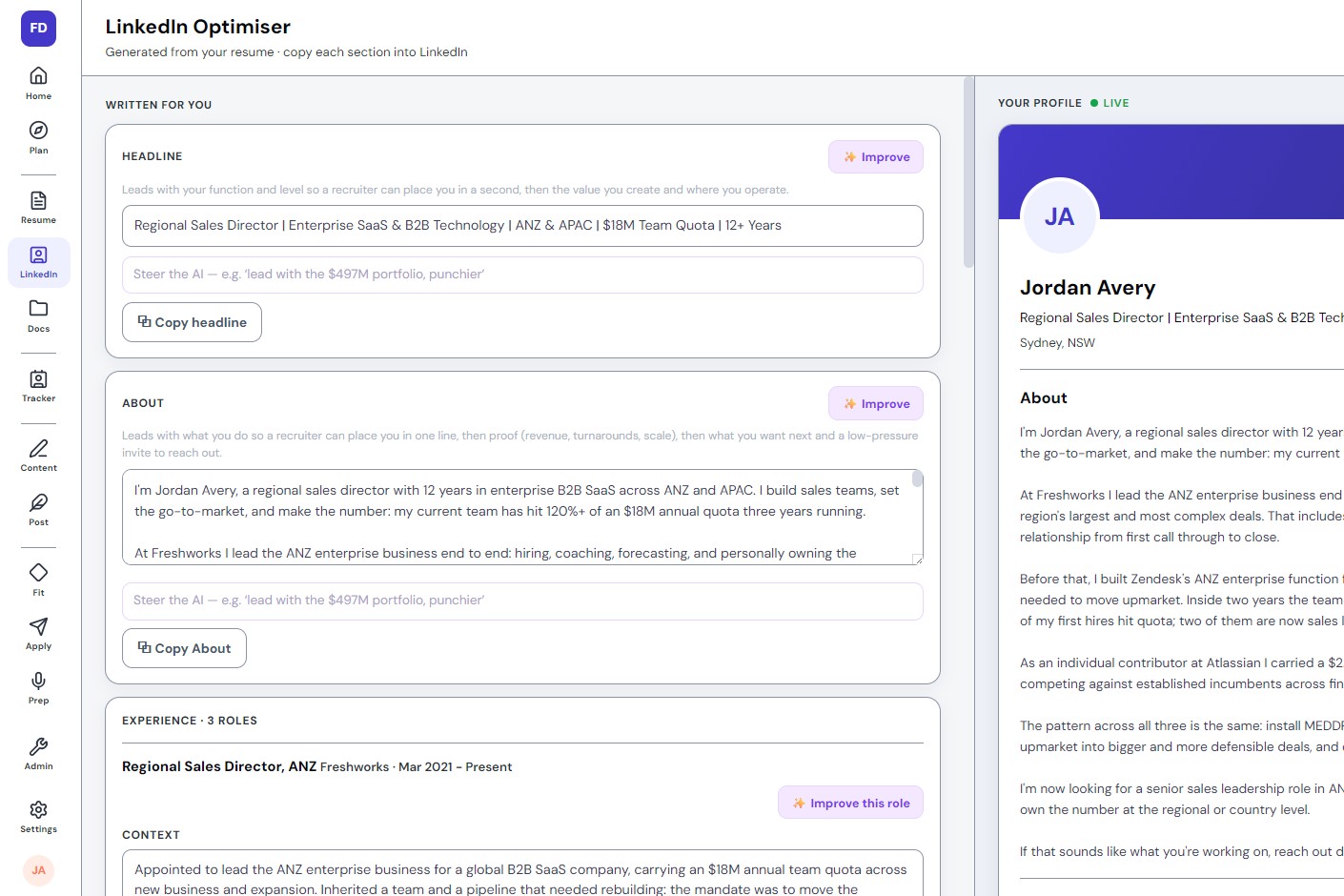
A recruiter needs to "place" a candidate, role and level, within the first two or three lines of an About section, before the "see more" click ever happens. Most job-seeker summaries take nine lines to say what could be said in two, because they open with a rapport-building line borrowed from consultant advice instead of stating plainly who they are. Four examples below show the fix across four different careers.
Open with the reader's problem. It's genuinely good advice, and it's completely wrong for a job seeker's About section. That line works for a consultant trying to make a stranger think "that's my situation." A recruiter isn't reading to recognize their own problem. They're reading to place a candidate, fast, and a summary that opens with anything other than who this person is and what they do is asking the reader to wait for information they need immediately.
The confusion is understandable. Most LinkedIn advice online is written for consultants, coaches and founders trying to attract clients, not for someone trying to get hired, and the two situations call for opposite openings. A prospect reading a consultant's profile is deciding whether to trust a stranger with money. A recruiter reading a candidate's profile is running a much faster, more mechanical check: does this person's background match what I'm looking for. Borrowing the wrong genre's opening line is the single most common reason a genuinely strong career reads as a weak summary.
Why does "open with the reader's problem" backfire here?
Because a recruiter's first task with any profile is classification, not persuasion. Before they can evaluate whether someone's any good, they need to know what role and level they're even looking at. A summary that opens with a story, a question, or a values statement delays that classification, and a delayed classification usually just means a closed tab. The fix isn't to be less interesting. It's to answer the classification question first, then use the room that's left to make the case.
What should the first two lines actually do?
Self-identify. Role, level, and specialism, stated plainly, the way a person would introduce themselves at the start of a conversation rather than three minutes into one. Everything that makes the case for why this person is good at the job can follow immediately after, but it follows, it doesn't lead.
Before: "I'm passionate about building high-performing sales cultures and love nothing more than helping teams reach their full potential in fast-paced, dynamic environments."
After: "Enterprise sales leader, fourteen years across SaaS and fintech. I build sales organisations from scratch inside companies scaling past their first $10M in revenue, and I've done it three times."
The first version could describe hundreds of sales leaders and tells a recruiter nothing they can act on for another two sentences. The second places the person completely in one line, then earns the rest of the read with a specific, checkable claim.
What does this look like across different careers?
The pattern holds regardless of function, only the specifics change. A finance leader opening with "I am a numbers-driven professional who thrives on turning complexity into clarity" is making the same mistake as the sales example above; "CFO for two SaaS scale-ups through Series A and Series B, currently building out the finance function for a third" does the same job of placing the person in one line that a stranger can immediately act on.
An operations leader who opens with "Dedicated operations professional passionate about process excellence and continuous improvement" is asking a reader to wait for facts that could arrive immediately: "Operations Director, twelve years in logistics and supply chain, currently rebuilding fulfilment for a 200-person retailer scaling three times faster than its systems can handle" places the same person in a single sentence.
A technology leader's version of the same mistake reads as "Innovative technology leader committed to driving digital transformation and building world-class engineering teams." The self-identifying version instead: "VP Engineering, eleven years building and scaling platform teams, most recently taking a 15-person team through a rebuild that cut deployment time from weeks to hours."
What's the line almost everyone leaves out?
What they actually want next. Most summaries make the case for who someone has been without ever stating what they're looking for now, target role, sector, or location. A recruiter reading a strong summary with no forward-looking line still has to guess whether this person is even open to a conversation, and guessing is exactly what a summary exists to remove. One closing sentence, stated as plainly as the opening one, closes that gap: what role, what kind of company, and if it matters, where. It doesn't need to sound like a job ad. "Currently exploring VP-level operations roles in mid-market logistics" does the job in one line, at the end, without turning the rest of the summary into a pitch.
A recruiter needs to place a candidate, role and level, within the first two or three lines of an About section, before the "see more" click happens.
"Open with the reader's problem" is consultant advice. For a job seeker, self-identify first: role, level, specialism, stated plainly, then make the case.
The pattern holds across careers, sales, finance, operations, technology, only the specific claim changes.
Most summaries never say what the person wants next. One closing line, target role, sector, location, closes that gap and tells a recruiter exactly what to do with what they just read.