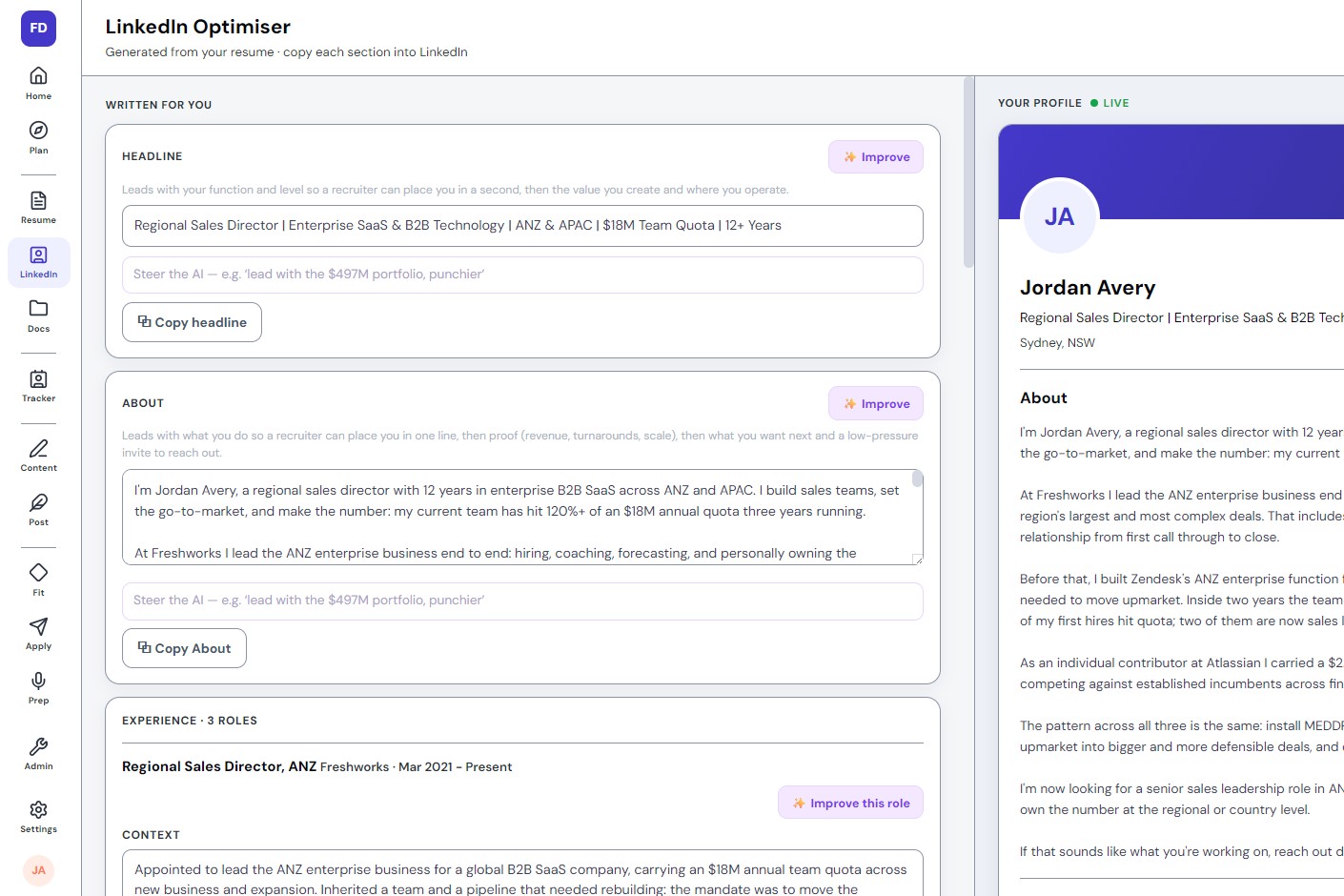
LinkedIn will mark your profile "All-Star" once every field is filled in. That badge checks completeness, not whether any of it actually works. A profile has three jobs, in order: get found in search, get believed once someone lands on it, and demonstrate real authority. Twelve sections do those three jobs, and most people have never worked out which section is doing which one. This is a section-by-section guide to all twelve.
LinkedIn will tell you your profile is finished. The "All-Star" badge checks whether you have a photo, a headline, two past roles, an education entry, five skills, a summary, and around fifty connections. It says nothing about whether a recruiter can find you, or whether they'd keep reading once they did. Finished and working are different things, and most advice about LinkedIn never separates them.
A profile that works is doing three jobs, in a specific order. It gets found, by showing up in the searches recruiters actually run. It gets believed, by surviving the few seconds someone spends deciding whether you're worth a closer look. And it demonstrates authority, by giving a reader proof instead of just claims. Twelve sections carry those three jobs between them. Here's which does what.
Get found: headline, skills, contact info
This job comes first because nothing else matters if a recruiter's search never turns you up. The technical character limit on a headline is 220, but only the first 30 or so display before truncation, in search results, in comments, in connection requests. Those 30 characters carry almost the entire weight of whether you show up in the right search at all.
The formula that earns its space: the target role you want, not the one you have, followed by the industry or function that narrows it, followed by one short credibility signal, a number or a scope.
Before: "Operations Manager | Problem Solver | Team Player"
After: "Head of Operations | Manufacturing & Logistics | Cut Fulfilment Costs 30% Leading 60-Person Teams"
The first version could describe thousands of people and tells a recruiter's search algorithm almost nothing to match against. The second names an exact role, an exact sector, and a number a hiring manager can picture immediately.
Skills sit underneath the headline as a second searchability layer, so keep the list current and ordered with the ones closest to your target role at the top, not buried under skills from a job you left five years ago. Recruiters searching by skill tend to look for the exact terms a job posting would use, not a close synonym, so match the language of the roles you actually want rather than the language of the role you happen to hold now. Contact info is smaller but easy to get wrong: if your email or the way you want to be reached isn't visible, a recruiter who wants to act on a good impression has nowhere to go with it. It's a small section that costs nothing to get right and quietly loses opportunities when it's ignored.
Get believed: photo, banner, About, experience, education, recommendations
Getting found only earns you a look. Six sections decide whether that look turns into anything.
Start with the photo, because it's the fastest trust signal on the page. LinkedIn's own data shows members with a profile photo get 21 times more profile views and 9 times more connection requests than those without one. A photo with a plain background, decent lighting, and a genuine expression clears this bar; a photo doesn't need to look professionally shot, it needs to look like a person a reader would feel comfortable messaging. The banner behind it is prime, mostly wasted, real estate. Most people leave the default LinkedIn blue in place, which isn't a mistake exactly, it's just an opportunity nobody took: a plain image related to your field does more work than nothing at all.
About is the one section written entirely in your own words, and it's also the one most people get backwards. Only the first two or three lines show before a reader has to click "see more," so those lines carry the job: place the reader fast, then persuade them. For a job seeker specifically, that means opening with who you are and what you do, not a rapport-building question the way a consultant's About might. A recruiter needs to place you within a couple of sentences.
Before: "Passionate marketing professional with a proven track record driving growth across diverse industries and business functions."
After: "I help mid-market companies build a marketing function from scratch once they've outgrown a single generalist hire. Twelve years in, four builds so far."
The first version could sit on almost any marketer's profile unchanged. The second could only be this person's, and it tells a reader exactly what problem you solve within the first sentence.
Experience should read the way a strong resume bullet does: what you did, how, and the result, not a list of duties. You don't need to rewrite your entire history for this, just the two or three most recent roles, since those are what a reader actually scans before deciding whether to keep going. Older roles can stay as a single line each; the return on rewriting a job you left a decade ago is close to zero. Education and certifications matter less than people assume, but they're a fast credibility anchor for a recruiter checking basic fit, especially in fields where a specific qualification is close to a hard requirement. Recommendations do the most work when they come from a former manager rather than a peer, since a manager's endorsement carries more weight on the specific question a recruiter is actually asking: would you hire this person again. A handful of specific, recent recommendations outperform a long list of generic ones from years ago.
Demonstrate authority: featured, posts and activity, calls to action
The last job is proving what the rest of the profile has been claiming. Featured sits directly under About, the highest-visibility real estate after the headline, and it's the only section built to show proof instead of asserting it. A project writeup, a piece of coverage, a talk, anything that lets a reader check a claim instead of taking your word for it. Most profiles leave this section empty, which means most profiles are making claims a stranger currently has no way to verify.
Posts and activity work more slowly, as a signal that you're an active, current professional rather than a static page someone set up once and never touched again. You don't need to post often for this to matter; you need the section to not read as abandoned. Calls to action are the finishing touch across all of this: make the next step obvious, whether that's an easy way to message you or contact details that are actually visible, so a reader who's decided you're worth reaching out to doesn't have to go hunting for how.
Not all twelve sections carry equal weight. Headline, experience, and featured decide more of the outcome than the other nine combined, because those three are exactly the ones a recruiter checks first, second, and third when deciding whether to act. Most people brace for the headline and never touch the other two.
Fix the right sections and the change shows up in specific ways: profile views start shifting toward your actual target sector instead of your current one, connection requests get accepted more often, and outreach messages you send start getting real replies instead of silence, without a single word of the message itself changing. Conversations open with a specific question about your work instead of "so, tell me about your background." The profile did that work before the conversation ever started.
A LinkedIn profile has three jobs in order: get found in search, get believed once someone lands on it, and demonstrate real authority. Twelve sections carry those jobs between them.
Get found: headline (only ~30 characters display before truncation), skills, and visible contact info.
Get believed: photo (21x more views with one), banner, About (only 2-3 lines show before a click), experience written as outcomes not duties, education, and recommendations from former managers.
Demonstrate authority: Featured as proof rather than assertion, active posting history, and a clear next step for anyone who lands on the page. Headline, experience, and Featured decide more of the outcome than the other nine sections combined.