Recruiters aren't binning resumes because AI touched them. They're binning the ones that sound like everybody else's and claim things nobody can check. Use AI to sharpen what you've done, never to add to it. If a line holds a number, a name or a result you couldn't talk about for two minutes in an interview, it shouldn't be there.
You've probably heard it by now. Recruiters can spot an AI resume a mile off, and straight in the bin it goes. It's half true, and the half that's true matters a lot if you've spent twenty years building a record worth reading. The resumes being binned aren't the ones AI helped with. They're the ones AI wrote instead of the person.
Do recruiters reject AI-written resumes?
Some do, and more of them are looking. TopResume, a resume-writing company, surveyed 600 US hiring managers in May 2025. One in five said they would reject a candidate with an AI-generated resume or cover letter. A third said they could spot one in under twenty seconds.
But read the same survey a bit further and the picture changes. Just over half, 52%, said using AI for proofreading or drafting support is fine. What they object to is a final product that doesn't sound like a person wrote it. So the problem isn't the tool. It's the result.
Why are recruiters so wary right now?
Because they're drowning. Greenhouse counted 244 applications per job in 2025, up from 116 in 2022. In its November 2025 report, 74% of US job seekers said they use AI, and 65% of US hiring managers said they had caught an applicant using it to deceive them. The company's CEO, Daniel Chait, called it an AI doom loop that's getting worse, not better. Job seekers use AI to send more applications, and employers use AI to filter them back out.
When you're reading your 200th resume of the week, two things jump out. Sameness, and claims that feel too neat to be true.
How can a recruiter tell a resume was written by AI?
It's rarely one word. It's the overall feel. The same polished verbs on every line. Results with no detail behind them. A summary that could belong to anyone in your field. Here's a line that turns up a lot right now:
Before: Spearheaded cross-functional initiatives that drove significant revenue growth and enhanced operational efficiency.
After: Took over a team that had missed target three quarters running. Rebuilt the call plan with them, and we hit target in the fourth.
The first line could be anybody's. Nothing in it can be checked, and nothing in it can be asked about. The second line is clearly one person's, and it hands the interviewer a question they want to ask.
The irony is that experienced people have the most to lose here. You have real stories, the kind a recruiter is hunting for, and a generic rewrite sands them down until you sound like someone with three years in the job. If your bullets read like the first line, turn them into achievements before anything else.
Is it OK to use AI on your resume at all?
Yes, and you'd be silly not to. AI is very good at the dull parts. It can tighten a rambling bullet, find the words a job ad uses for something you've already done, catch the typo you've read past six times, and tell you your summary is four lines too long.
Used that way, it's a sharp editor. The words and the facts are still yours, and AI makes them easier to read. The trouble starts when it moves from editing what you've done to adding to it.
What should AI never do to your resume?
This is the line. AI should never add a fact you didn't give it:
- a number or a result ("grew revenue 40%")
- a job title you didn't hold
- a company, client, product or tool you haven't named
- a date or a qualification
Every one of those is a claim, and claims get checked. A reference call, a background check, or an interviewer who simply asks, "Tell me more about that 40%." If the AI made it up, you're the one in the chair trying to explain it.
It's also worth knowing that AI doesn't mean any harm by it. It's built to produce something that sounds good, and a nice round number sounds good. That's exactly why you have to check.
How do you check an AI-edited resume before you send it?
Read every line and ask one question: could I talk about this for two minutes without notes? If the answer's no, either it isn't true, or it's true but doesn't sound like you. Both are worth fixing before a recruiter finds them.
Then check the numbers one by one against what you know. If you can't remember where a figure came from, take it out. A resume with three real numbers beats one with ten that wobble. Finally, read it out loud. If it sounds like a press release, it'll read like one too. To see what real lines look like, the resume examples by job show a full resume and why every line works.
Where FutureDay fits
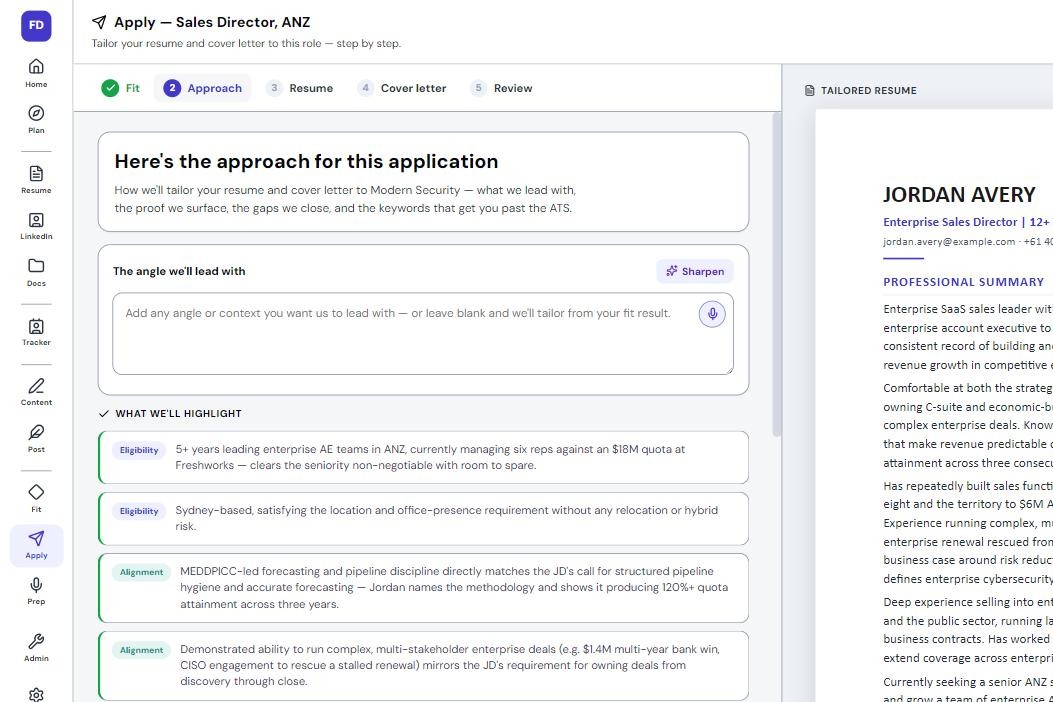
We built FutureDay around that line. When it tailors your resume to a job, it uses the job ad's own words for things you've actually done. If the ad says "strategic accounts" and you wrote "key clients", it can make that swap, because they mean the same thing. It never adds a number, a result, a job title, a company, a date or a qualification you didn't give it.
And we don't just ask the AI nicely. For names and numbers, the code checks every line. If a figure or a name shows up that isn't on your resume, your own words go back in, and we show you exactly where it happened. Skills the job asks for that aren't on your resume only go in if you tick them, because a tick is you saying, "Yes, I've done that." You send every resume yourself. FutureDay works on it with you, not for you.
Recruiters aren't binning resumes because AI touched them.
They're binning the ones that sound like everyone else's and claim what can't be checked.
Use AI to edit what you've done, never to add to it.
If you couldn't talk about a line for two minutes, cut it.