This is Stop Applying, Get Hired, a weekly newsletter on how experienced professionals actually get hired. Every week: one idea, the research behind it, and one thing to try in your search.
You know the night. You open the laptop to work on your search. There’s a LinkedIn message from Sarah from two weeks ago that you meant to answer. A recruiter’s email you’ve read three times. A note on your phone that says “follow up Mark?” with no date. You can’t remember whether you sent Mark that follow-up, or just thought about it.
An hour later you close the laptop. You’ve read a lot. You haven’t sent anything.
If that’s you, you’re not lazy and you’re not disorganised. You’re running a search across three different places, with nothing that tells you what to do next.
Why it isn’t working
I talk to experienced job seekers every week. Most of them know exactly what to do. One man put it plainly: “I know how to do all of this. I just lose track. I do something, I can’t remember if I’ve done it, and I forget to follow up.”
That came up, in different words, on almost every call.
Another had forty conversations going across email, LinkedIn and his phone. He was good at his job and had been for years. What he didn’t have was one place that told him which conversation needed him today.
In business, we’d never run it like that. We have a CRM and systems to manage every conversation. In our job search, we’ve got a bit of paper and a pen.
That’s the real problem. At our level, a search doesn’t run on applications. It runs on conversations: a former boss, a recruiter, a friend of a friend at a company you’d love to join. Each one is at a different stage, and each needs something from you at a different time. A reply. A thank-you. A nudge in a week. Keep all of that in your head and something always slips.
And what slips is usually the follow-up, which is where the job tends to be. In Ashby’s study of 38 million job applications, 40% of people who were referred got an interview. Of those who applied cold, 3% did. Referrals come out of conversations you kept going. So a follow-up you forgot isn’t a small slip. It might be the introduction that would have got you in the door.
What works instead
Small things, every day, in one place.
A search is rarely won in one great week. It’s won by the person who keeps doing the small things when nothing seems to be working. A short list each morning beats a long plan nobody follows. And one place, so nothing lives only in your head. On a day the inbox stays quiet, it’s the difference between “nothing happened” and “I moved it forward.”
The other half is knowing what to say. Most of us know who we should message. We don’t send it because we don’t know what to write, or whether it’s too soon to follow up. So it sits there, and the conversation goes cold.
One thing to try this week
Make one list. Every person you’ve spoken to or messaged about your search in the last month. Four columns: their name, where you talked (email, LinkedIn, phone), the date you last heard from them, and what happens next.
Then each morning, open it and do the next thing for two people. That’s it.
Here’s what I’d send after a good chat:
Hi Sarah, thanks for making the time. Really useful to hear your take, and I’ll follow up on anything I said I’d send.
Then a week or so later, ask the question most people forget to ask:
Hi Sarah, thanks again for making the time the other day. Is there anyone you think I should be talking to? An introduction would mean a lot, and I’m happy to send a short note you can pass on.
That second message is where one conversation turns into two. Offering to write the note makes it easy for them to say yes.
If it goes quiet
Some won’t reply. That’s normal. People are busy, and your message is one of fifty in their inbox. Give it a week, then send this:
Hi Sarah, I know you’re busy, so no pressure at all. If you’re unable to help right now, that’s completely fine. If you could let me know either way, I’d really appreciate it. And if you know of anyone else who might be able to help, I’d be grateful for a pointer.
It gives them an easy way out, and people often reply to it when they ignored the first one. Then mark it on your list, and move to the next name.
And if you know someone running their search out of their inbox, LinkedIn and a note on their phone, send this to them.
Cheers,
Grant
What do experienced job seekers actually want?How do you track your contacts, companies and roles?
Subscribe to Stop Applying, Get Hired
One idea a week you can use that week, delivered to your inbox.
Free, every Tuesday, from Grant. Plus my free guide straight away.
You're almost in. Check your inbox and click the link to confirm. As a thank-you, the free mini guide to Stop Applying, Start Getting Hired comes straight after.
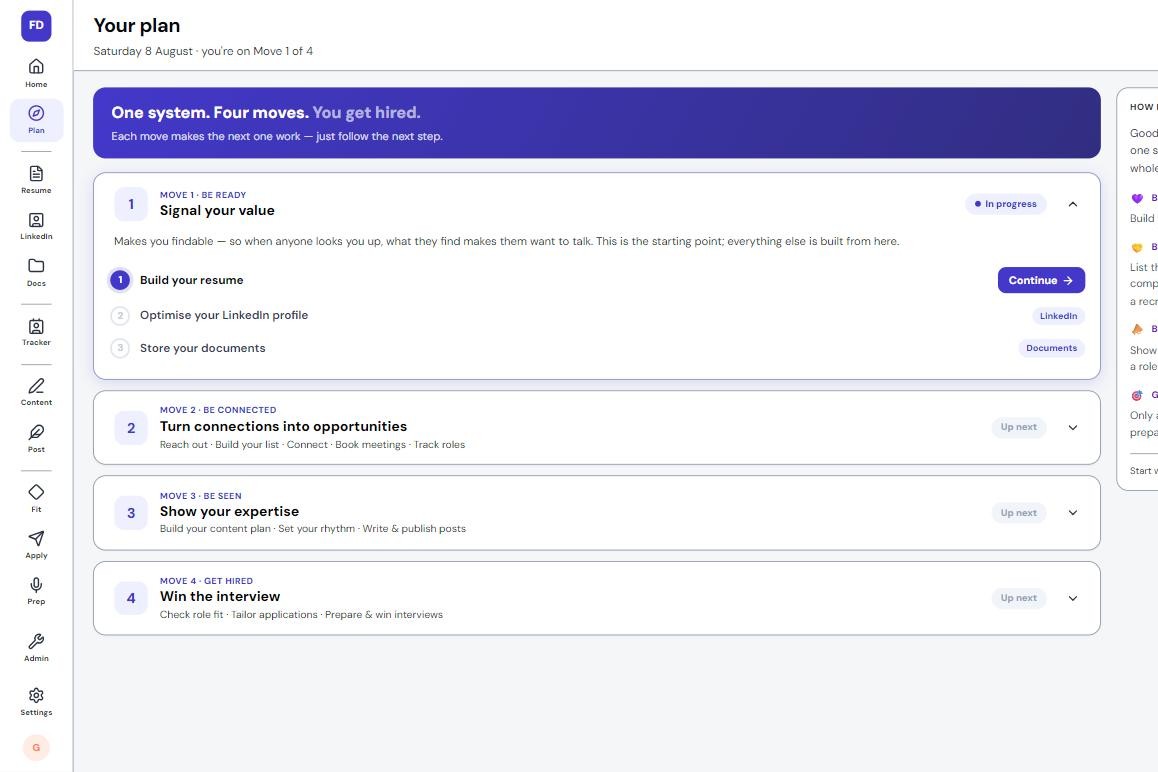
FutureDay shows you what to do next to get hired, every day, through the people who already know you. Start with 14 days for $1.
Want more hands-on help? I coach a small number of experienced professionals through the modern job search, one to one, with FutureDay running alongside. Book a free 20-minute call.