I built FutureDay because running a search the way I always have meant a spreadsheet, two AI chat windows and a handful of other apps, and keeping it together cost me time and a lot of stress. Every job I've had but one came through someone I knew, and I found them the same way I find customers in sales. FutureDay puts that method in one place and gives you the next step each morning. You send every message yourself.
The method always worked. Keeping it together didn't. A search like mine lived all over the place. I'd be reaching out to people on LinkedIn. I had contacts in an Excel spreadsheet I'd built to keep track of who was who, drafts in ChatGPT and Claude, and follow-ups in a CRM or on my phone. I was in Word one minute and my calendar the next, then writing emails, then on Google looking up a company.
None of it talked to the rest. I lost track of who I had messaged. And I spent far too much time every day prompting AI for a better resume, when the resume was never the problem.
All that switching took more out of me than I expected. Every app was one more place for something to slip, and the anxiety and the stress built with it.
Somewhere in the middle of all that I thought: there is a better way to do this, and I could build it. I wanted everything in one place. FutureDay is what came out of that thought.
Who am I?
My career has been in selling technology to large companies. I've led teams across twenty countries. Along the way I've hired a lot of people, and I've had to let a lot of people go.
I've also been between jobs more than once, as most people in senior roles are. So I know the job search from both sides: the side that reads the applications and makes the calls, and the side that waits for the phone to ring.
How did I find my jobs?
Every job I've had but one came through someone I knew. It didn't always happen the same way. Sometimes I told people I was looking and asked for their help. Sometimes someone rang me while I was still in a job. And sometimes I saw a role and asked the people I knew at that company to recommend me.
Looking back, I found work exactly the way I find customers in sales. You start with the people who already know you. You pick the companies you want. You find the person inside who can open a door. And you reach them before the job is ever advertised.
I've been on LinkedIn for years, using that same outbound approach to prospect for clients. Prospecting companies and the people inside them is the same system whether you're selling or looking for a job. I never called it a system until I sat down and wrote out how I find customers. When I did, I could see it was how I'd found almost every role I've had.
Why does knowing someone inside a company matter so much?
Because it changes how you're read. LinkedIn's hiring data shows that applicants already connected to an employee are 3.6 times more likely to be hired. A cold application gets screened for reasons to say no. When someone already knows you, they're reading for reasons to say yes.
That's how I think about the resume, too. A resume is proof. Someone already knows you, and your resume validates what you've told them and shows you operate at their level. A good resume and a strong LinkedIn profile are the bare minimum. They get you into the pile. They don't get you out of it. People do.
Why did I build FutureDay?
Because the method works, and running it by hand is hard. A search like this runs on a lot of people, companies and roles at once, each at a different point and each needing a different next step. Keep it in a spreadsheet and a few chat windows and things slip. The follow-up you meant to send doesn't go. The person who offered to help hears nothing back.
So I started with the parts that have to be right, beginning with the resume. Writing my own resume turned out to be a different skill from reading other people's. I'd lose days, sometimes weeks, fine-tuning it, so I went and researched best practice properly and built it in. I studied what makes each one work: a resume bullet, a headline, a key achievements section, a LinkedIn About section, the Featured section. Then I wrote a best practice guide for every one of them. Those guides are the baseline for everything FutureDay writes with you.
I also worked out two more things. How to judge whether you're a genuine fit for a job before you apply for it. And how to tailor a resume to a job without adding a single fact that isn't already yours.
Bringing it all into one place takes a lot of the anxiety and stress away. You turn up knowing you'll get an excellent resume out of it, without spending days toggling around and fine-tuning. It keeps you honest and on track. It gives you the messages to write and send, so you don't have to think about the words; you make each one yours and send it. It saves a whole heap of time and a whole heap of stress, it delivers a better result, and it keeps you accountable.
What does FutureDay do?
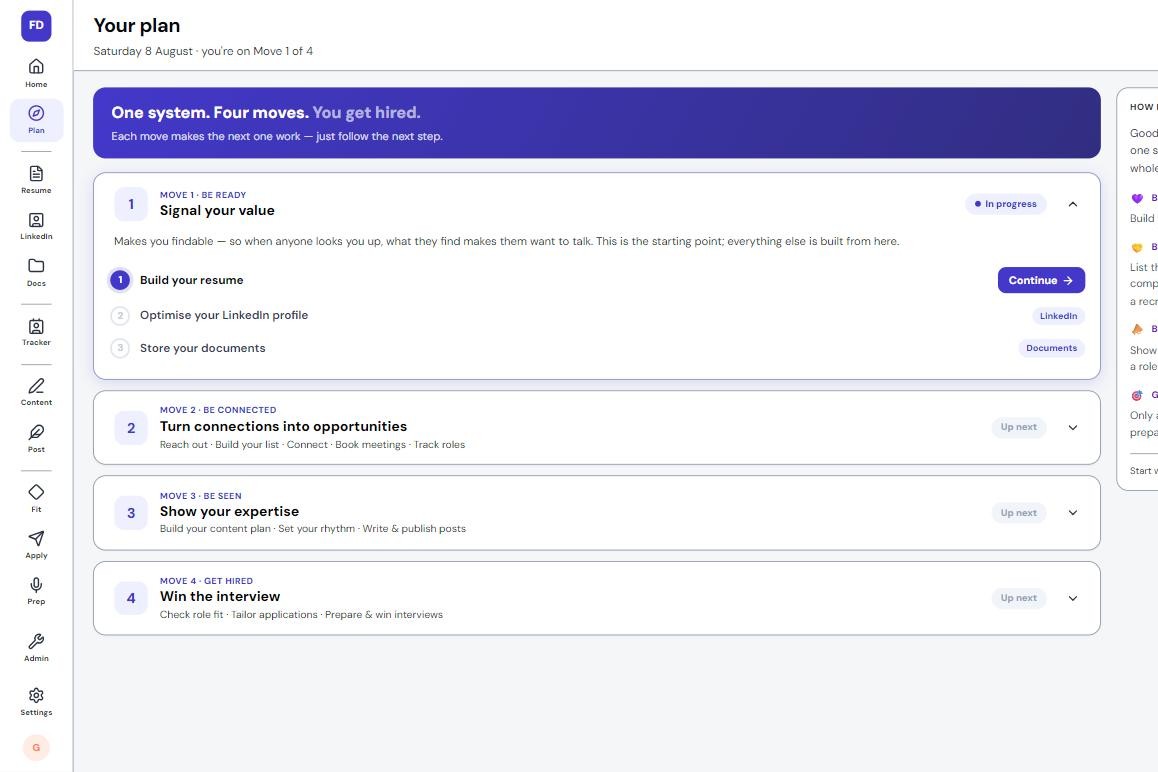
It follows four moves, the same four I've always used.
Be Ready. FutureDay builds your resume and your LinkedIn profile with you, to those guides.
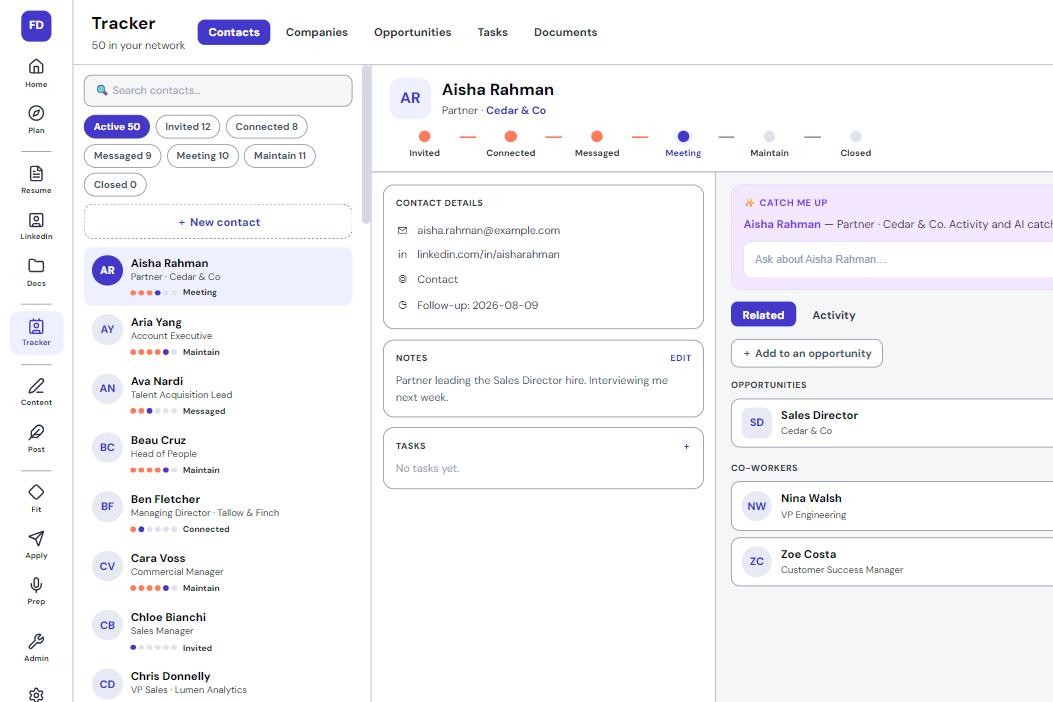
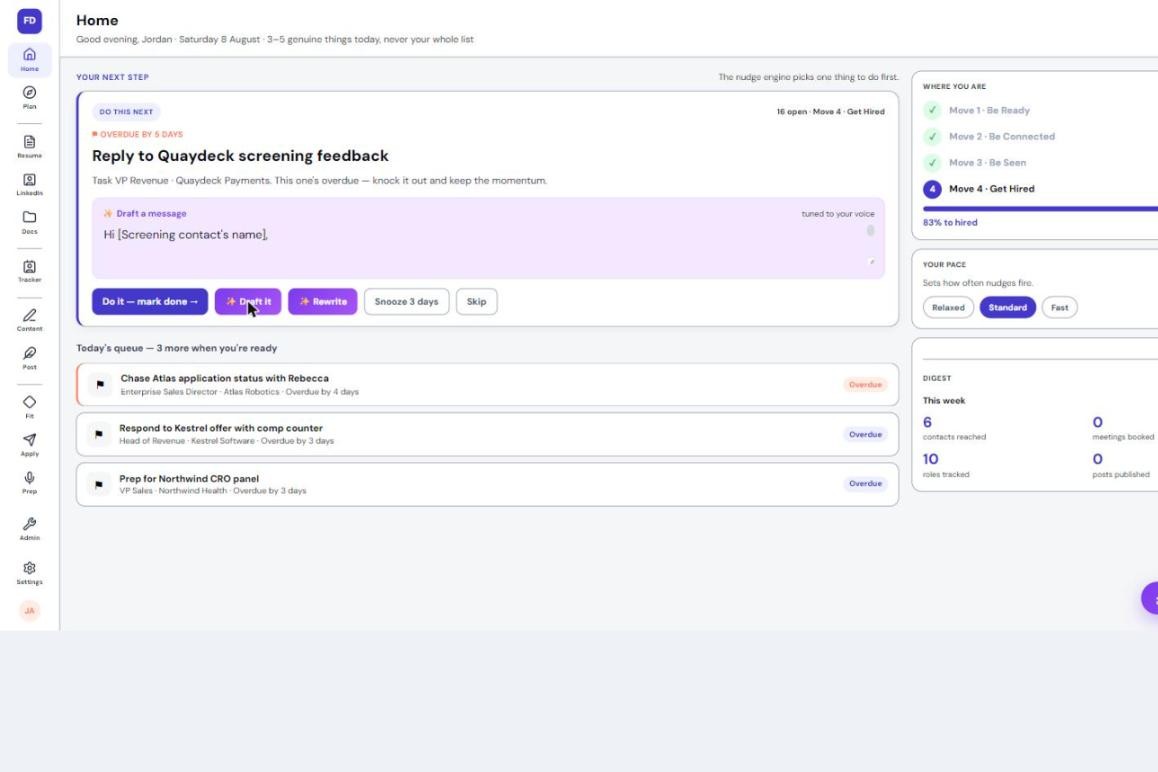
Be Connected. Every person, company and job lives in one place, so nothing gets lost and the follow-ups happen. Each morning, Home shows you what to do next and the few things that matter today: who to contact, what to say and when, with the exact message ready to copy.
Be Seen. A content plan and a posting rhythm, with help writing each post. You approve every one. The picture I have in mind is simple. Your profile says you're open to work, and your posts have already shown the people in your network the level you work at. So when a role opens, someone thinks “why don't I just reach out to them?” instead of paying to run a search.
Get Hired. When a role comes up, a fit check tells you whether you're a genuine fit before you apply. Then a resume and cover letter tailored to that job, and interview prep for when the call comes.
Through all of it, FutureDay works with you. You send every message yourself. It keeps the thread and tells you what to do next.
Who is FutureDay for?
I'm not an extrovert. Plenty of people who are very good at their jobs aren't natural at selling themselves either. Some lack confidence. Others simply don't know what to say to someone they haven't spoken to in years.
FutureDay is written for them. When you're out of work you have too much on your plate, and it's easy to feel overwhelmed. This makes it simple: turn up, do today's step, and come back tomorrow. And whatever you use, any system you lean on is better than trying to wing it.
Where should you start?
If you'd like to see the method on its own first, the Off-Market Method sets it out in full. And if it sounds like the way you'd want to run your own search, the box at the end of this page is where to start.
A search run my way lived in a spreadsheet, two AI chats and a handful of apps, and it was easy to lose track of who I'd messaged.
Putting it in one place takes a lot of the stress away, saves time and gets a better result.
Every job I've had but one came through someone I knew, found the way I find customers in sales.
Applicants already connected to an employee are 3.6 times more likely to be hired, in LinkedIn's hiring data.
A resume and a LinkedIn profile get you into the pile. People get you out of it.
FutureDay runs the four moves with you, and you send every message yourself.
 21 pages, a 15-minute read