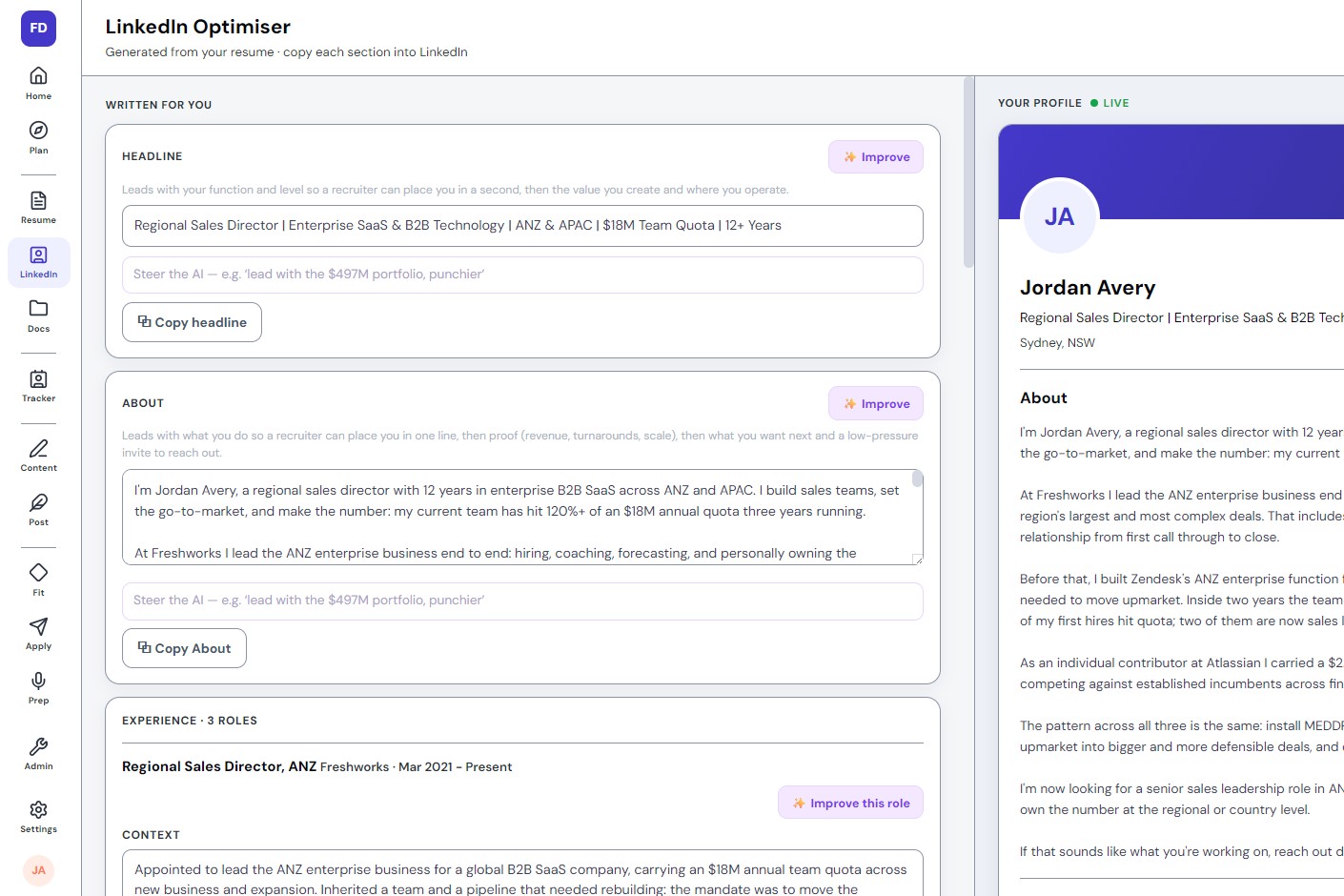
A LinkedIn profile isn't one thing. It's three separate assignments running at once: get found in search, get believed once someone lands on it, and demonstrate real authority. Most profiles were built as a single static bio, which means they're quietly failing at least one of the three jobs, and nobody who built it can tell which one from the inside.
A profile can be fully filled in, every field populated, photo uploaded, summary written, and still produce nothing. That's not a contradiction. It's a sign the profile was built as one thing when it actually needs to do three different jobs, and most people have never separated them enough to check whether each one is working.
Why does a "finished" profile often do nothing?
Because finishing a field and that field doing its job are two different achievements. A photo exists doesn't mean it builds trust. A headline exists doesn't mean it gets found in a recruiter's search. Most people fill in every section once, in whatever order LinkedIn presents them, and never ask what job each section is actually meant to be doing for a stranger reading it.
What's job one: getting found?
This job runs entirely on two fields: the headline and the skills list. A recruiter runs a search using specific words, typically the exact job title and a handful of skills, and a profile either contains those words or it doesn't show up. This isn't about being interesting. It's a matching problem, mechanical and unforgiving, and it happens before anything else on the profile gets read.
Most people write their headline to describe their current role rather than the role they want next, which means the profile gets found by the wrong searches, if it gets found at all. The skills list usually fares worse, left in whatever order it was first entered years ago, with the actual target skills buried under ones from a job that ended a decade back. Recruiters searching by skill tend to look for the exact term a job posting would use, not a close synonym, so a skills list that hasn't been reordered or refreshed in years is quietly working against the very role someone's trying to move into.
What's job two: getting believed?
Getting found only earns a look. Six sections decide whether that look turns into anything: photo, banner, About, Experience, education and certifications, and recommendations. Together they answer a single question a stranger is running in the background: is this person actually who the headline claims they are.
Experience carries the most weight here, and it's also where the gap is widest. A list of duties reads as a job description. A list of outcomes reads as evidence.
Before: "Responsible for the APAC customer success function, overseeing renewals and reducing churn."
After: "Led APAC customer success for 40+ enterprise accounts. Rebuilt the renewal playbook and cut annual churn from 18% to 9% in under a year."
The first version could belong to almost anyone who has ever held a customer success title. The second could only belong to this person, in this role, with this result, and it's the second version that gets someone believed rather than just noticed.
What's job three: demonstrating authority?
The last job is proving what the rest of the profile has been claiming. Featured sits directly under About, the highest-visibility real estate after the headline, and it's the only section built to show proof instead of asserting it. An article, a project writeup, a talk, a piece of coverage, anything a stranger can actually check rather than take on faith. Most profiles leave this section empty, which means most profiles are making claims nobody currently has a way to verify.
Posts and activity work more slowly, as a second, quieter authority signal: proof that the person is current and active rather than a page someone filled in once and never returned to. Neither section needs to be dramatic. It needs to exist, and it needs to actually back up what the rest of the profile says.
Why does separating the three jobs actually matter?
Because fixing the wrong one changes nothing. Someone whose profile isn't getting found doesn't need a better About section, they need a headline that matches how recruiters actually search. Someone who's found constantly but never contacted doesn't have a findability problem at all, they have a believability problem, and no amount of headline tweaking will fix an Experience section that reads like a duty list. Someone whose profile gets found and believed, but who still never hears from anyone worth hearing from, is usually missing the third job entirely, an empty Featured section and a dormant activity feed that never gave a stranger anything to check.
A quick way to test which job is actually broken: profile views with almost no follow-up contact points to job two, believability, since people are finding it and walking away unconvinced. Very few profile views at all, despite a genuinely strong background, points to job one, findability, since the searches that should be surfacing the profile simply aren't. Treating the profile as three separate jobs, and diagnosing which one is actually broken, is what turns a vague sense that "LinkedIn isn't working" into something specific enough to fix.
A LinkedIn profile runs three separate jobs at once: get found, get believed, and demonstrate authority. Most profiles were built as one thing and are quietly failing at least one of the three.
Get found runs on the headline and skills list matching the exact words a recruiter searches for.
Get believed runs on six sections, with Experience carrying the most weight, outcomes over duties.
Demonstrate authority runs on Featured (proof, not assertion) and active posting. A profile that separates these three and checks each one finds the actual problem instead of guessing at it.