Welcome to the first edition of Stop Applying, Get Hired, a weekly newsletter on how experienced professionals actually get hired. Every week: one idea, the research behind it, and one thing to try in your search.
You know the week. On Monday you find three roles that fit. You spend the evenings tailoring your resume for each one, swapping “led” for “spearheaded” because the ad said so. By Thursday you’ve heard nothing. Not a no. Nothing. The following Monday, you start again.
If that’s you right now, you’re not doing anything wrong. You’re doing exactly what we were all taught. It’s just that it only uses one of the two doors into a company.
Why it isn’t working
The job ad is the front door. Everyone can see it, so everyone queues at it.
Greenhouse, one of the big hiring systems, counted 244 applications per job in 2025. Back in 2022 it was 116. So the queue has more than doubled in three years, and it hasn’t got any faster. About 3 in 10 of those jobs closed without anyone being hired at all.
That’s why trying harder doesn’t help much. A better resume moves you up a queue of 244. Sending more of them just puts you in more queues. And after enough silence, most people start to wonder if the problem is them. It usually isn’t. It’s the door.
What works instead
The side door is someone inside who already knows your name.
A cold application asks a stranger to take a chance on a piece of paper. A word from someone they trust asks them to trust that person instead, which is a much easier yes. I’ve sat on the hiring side for years, and when someone I trusted said “you should talk to this person”, I paid attention. It didn’t mean they got the job. It meant they got the conversation, which is more than the other 243 got.
The numbers back it up. In Ashby’s study of 38 million job applications, 40% of people who were referred got an interview. Of those who applied cold, 3% did.
So why doesn’t everyone use the side door? Mostly because asking feels awkward, like turning up only when you need something. Fair enough. But it rarely lands that way on the other end. Most people are glad to hear from you, and quietly pleased you asked what they think.
One thing to try this week
Write down 20 people who know your work. Former managers, colleagues, clients, suppliers, the person who sat next to you for six years and knew how you took your coffee. People you haven’t spoken to in years count too. One study of executives found that people they hadn’t spoken to in three years or more gave advice just as useful as their current contacts, and often fresher.
Then message two of them today, and two a day after that. Here’s what I’d send.
For someone you know:
Hi Sarah, I’m looking for my next role. I’d really value your view on what you’re seeing out there. Any chance you’ve got time for a quick chat next week?
If it’s been a few years, add one line only they’d recognise, like the project you worked on together. It reminds them who you are before you ask for anything.
For someone at a company you’d love to work for:
Hi Mark, I’m looking for my next role, and [company] is somewhere I’d really like to work. Would you be open to a quick chat about what it’s like there? And if you’re not the right person, a pointer to whoever is would be a big help.
Notice what neither message does: ask for a job. They ask for a view, which is easy to say yes to. And a good conversation has a habit of turning into the next one.
At two a day, you’ll be through all 20 in a couple of weeks. The hardest part is pressing send on the first one. After that it’s just admin.
If it goes quiet
Some won’t reply. That’s normal, and it almost never means no. People are busy, messages get buried, and a LinkedIn inbox is where good intentions go to die.
Give it about a week, then send one short nudge:
Hi Sarah, just following up. Would a quick call next week work?
Still nothing? Let it go, no hard feelings, and move to the next name. You’ve got 18 more.
And if you know someone who’s been sending application after application and hearing nothing, send this to them. It might be the nudge they need.
Cheers,
Grant
Subscribe to Stop Applying, Get Hired
One idea a week you can use that week, delivered to your inbox.
Free, every Tuesday, from Grant. Plus my free guide straight away.
You're almost in. Check your inbox and click the link to confirm. As a thank-you, the free mini guide to Stop Applying, Start Getting Hired comes straight after.
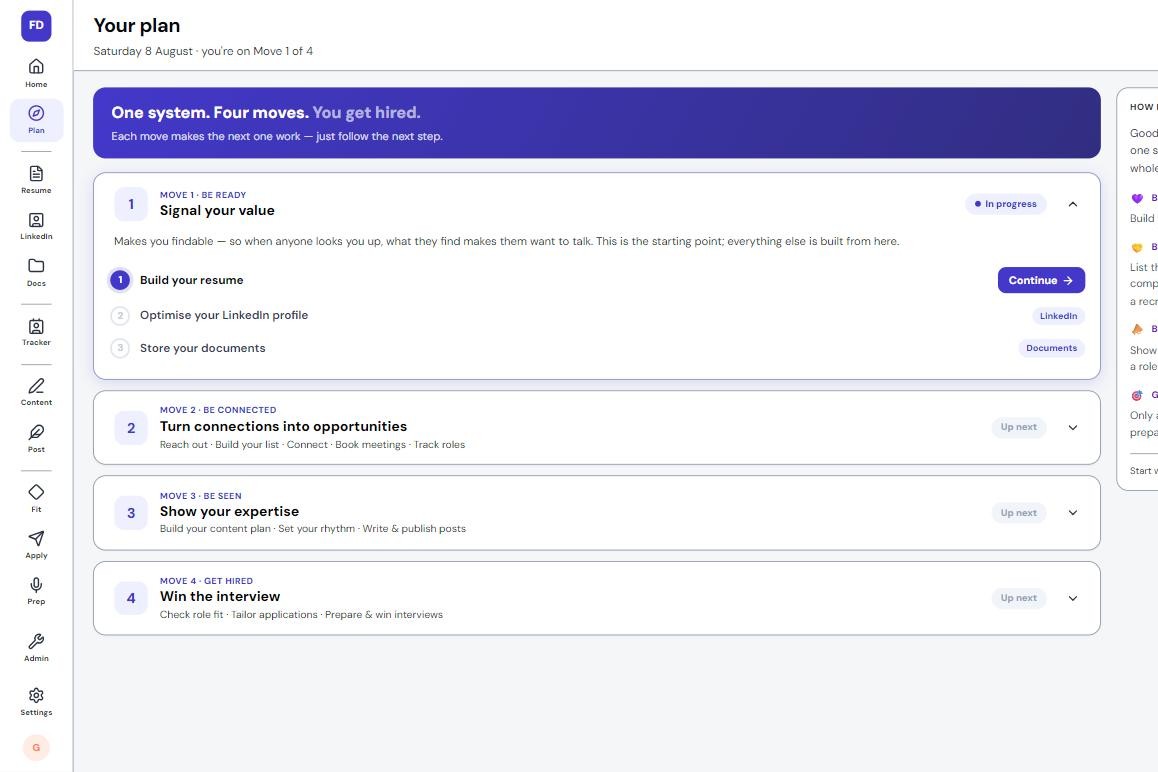
FutureDay shows you what to do next to get hired, every day, through the people who already know you. Start with 14 days for $1.
Want more hands-on help? I coach a small number of experienced professionals through the modern job search, one to one, with FutureDay running alongside. Book a free 20-minute call.